THE PERSON BEHIND THE ACCOUNT
The change of life behind a patron of cancer patients
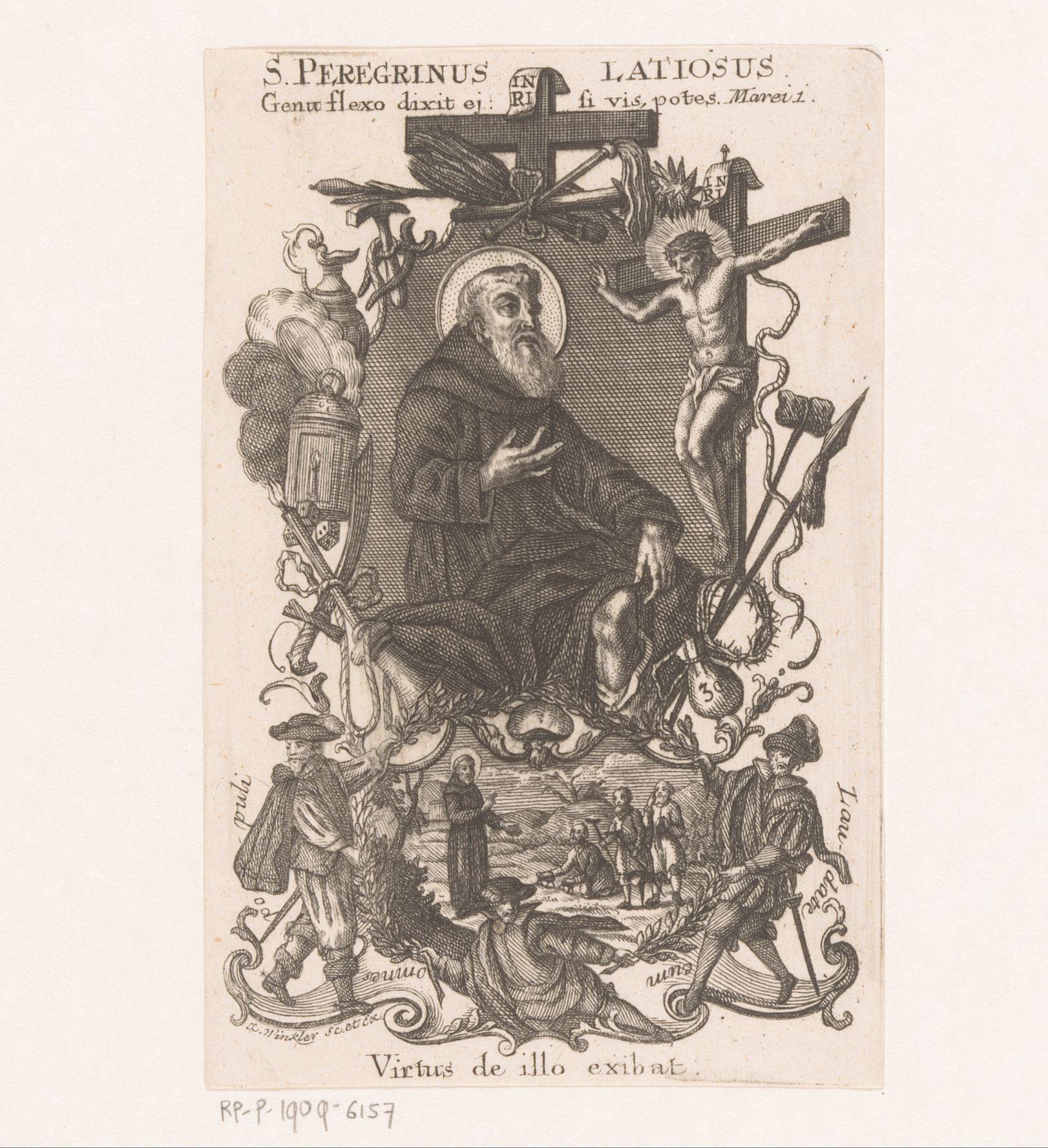
Peregrine’s older story begins in a divided Forlì, before the illness that made him a patron of people with cancer. The Church’s cause biography links his youth with opposition to papal authority, while acknowledging uncertainty about his conversion. [1]
A disputed slap and a real change of allegiance
The familiar account says Peregrine struck Philip Benizi, the Servite superior, during unrest in Forlì. Some biographies make the encounter the decisive instant of his conversion. The Dicastery’s account is more cautious: it calls the episode controversial among hagiographers and says the precise circumstances of his conversion are uncertain. [1]
Servite entry, a novitiate at Siena and return to Forlì form the stable outline. He was a religious brother, rather than a priest. The change gave his life in the town a new religious setting. [1]
Returning to the people he knew
The diocesan shrine’s biography describes work among people who were poor and sick and a life of strong penance. His reputation grew in the city where he had previously been associated with hostility. We cannot reconstruct every act of reconciliation, but the tradition places his service among his neighbours rather than in a distant setting. [2]
The standing penance belongs to medieval ideas of repentance. It supplies neither a medical cause of a tumour nor a practice patients must repeat to deserve care. [1][2]
IN OUR OWN LIVES
A patron for people who need company
Peregrine’s story can accompany illness without promising a cure. Readers can also meet the younger man and his years of religious service. Forgiveness and care belong beside the famous healing in his memory. [1][2]
THROUGH THE EYES OF FAITH
Faith and daily life
For the Servite tradition, his vocation joined devotion to Mary and Christ with concern for poor people. The enduring appeal is personal: a man remembered both for needing forgiveness and for needing help when illness threatened his life. [1][2]
The night before an operation
The received healing account tells of a worsening leg lesion, physicians preparing to amputate, and Peregrine praying before a crucifix. It describes a dream of Christ healing him and a subsequent recovery. These are the events as transmitted in his religious biography. The accounts do not preserve the kind of pathology evidence needed to identify a disease retrospectively. [1][2]
His popularity among cancer patients rests on that association with grave illness and hope. The Philippine diocesan shrine emphasizes trust in God amid sickness. Such devotion can give someone language for fear, dependence and companionship. It should not turn a particular outcome into a test of the patient’s faith. [2]
THROUGH THE LENS OF SCIENCE
The evidence about the remains
The leg-healing narrative is not a surviving modern cancer diagnosis. Separate evidence confirms custody of his remains at Forlì and a new research project involving medical technology in 2026; an announcement of research is not a set of results. [3][4]
An old story in modern cancer literature
A 2014 immunology review opens with Peregrine’s story when discussing historical reports of cancer regression associated with infection. That is a use of a traditional narrative to introduce a scientific subject. The article does not present a new examination of his lesion, preserved diagnostic slides or contemporary clinical records. [5]
The distinction prevents a circular argument. A medical paper repeating a saint’s biography does not independently validate the biography’s diagnosis. Research on cancer biology can be important in its own right while leaving the disease and course of one medieval illness uncertain. [5]
The Forlì remains and the 2026 study
The municipality identifies the glass casket in the Basilica of San Pellegrino, also known as Santa Maria dei Servi. A Servite provincial history preserves a seventeenth-century description calling the body entire. That is historical testimony about veneration, not a present tissue inventory. [3][6]
In 2026, the cooperative federation representing the transport provider reported that Elcas supplied an ambulance and trained staff for a research transfer. It identified paleopathologist Mirko Traversari and the University of Bologna. This first-party operational account confirms a study involving the remains; it gives no final findings about disease, preservation or age. [4]
Until technical findings are published and assessed, the new work should be described as research in progress. Neither a photograph of the casket nor a news announcement can establish an untreated, wholly preserved body or a supernatural cause of preservation. [3][4]
READER QUESTIONS
Questions and answers
Was Peregrine certainly suffering from cancer?
The traditional accounts describe a grave leg condition and recovery. They do not supply modern diagnostic evidence. A medical article’s use of the story is not independent confirmation of a medieval cancer diagnosis. [1][5]
Have the 2026 investigations established how his body was preserved?
The first-party research-transfer notice used here publishes no such results. A technical report would need to be read before making that claim. [4]
FOLLOW THE SOURCES
Sources and further reading
- Dicastery for the Causes of Saints: Peregrine
Church or shrine source
Acknowledges hagiographical uncertainty about the confrontation/conversion; supports religious-brother status and received healing narrative. Does not supply modern diagnostic evidence.
- Peregrine Parish and Diocesan Shrine: biography
Shrine account
Received account of service, penance, illness and devotion. Dates and disease labels are not treated as clinical findings.
- Municipality of Forlì: Santa Maria dei Servi
Local authority record
Current location and glass-casket description. No anatomical or treatment inventory.
- Confcooperative Romagna-Estense: Elcas research transfer
Participating institution’s account
First-party cooperative-federation account of transport for 2026 research coordinated by Traversari; no final scientific findings.
- Krone, Kölmel and Grange: immune system and cancer review, 2014
Scholarly account
Uses Peregrine narrative as historical opening to immunological discussion; no independent case examination of the medieval lesion.
- Servite province: Forlì convent history
Religious order’s history
Transcribes 1650 description of an entire body and later custody history. Historical text is not a current forensic finding.
Sources checked: 2026-10-27. Suggest a correction or a source.