THE PERSON BEHIND THE ACCOUNT
Solitude needed a community
Romuald is remembered as a solitary, yet his lasting achievement required organization. At Camaldoli, individual cells belonged to a community with a prior, a rule and shared worship. A monastery below the hermitage provided another form of life. His legacy asks how silence can be sustained without abandoning responsibility for other people. [2][3]
Leaving a household marked by violence
The early biographical tradition connects Romuald’s entry into monastic life with a killing in which his father was involved. The Catholic Encyclopedia recounts the story as a duel and places the young nobleman at Sant’Apollinare in Classe, near Ravenna. Exact birth dates differ among the biographies; the broad setting is the tenth century. [1]
His subsequent movement between teachers and houses is more useful than making the first crisis an invented conversion scene. The biography follows him from communal monastic life to an eremitical teacher near Venice and then to Cuxa in Catalonia. He learned different forms of religious discipline before developing communities of his own. [1]
A reformer who kept moving
Romuald’s later life involved repeated foundations and journeys. He did not simply withdraw once and remain in a single cell. The older biography even records an intended journey to Hungary prevented by illness. Teaching other people how to live apart required considerable travel and contact. [1]
At Camaldoli the institutional history preserves competing foundation dates. The traditional 1012 date appears in a much later deposition; other evidence points to the 1020s. The difference does not erase Romuald’s role, but it warns against the tidy story of one perfectly documented founding day. [2]
IN OUR OWN LIVES
A workable form of quiet
Romuald’s contribution has a practical edge for an age of distraction. His communities did not leave the search for silence to willpower alone; they gave it places, habits and relationships. His brief instruction also made room for failure of attention. That combination of structure and patient return is a more useful starting point than an idealized picture of escape. [2][3][4]
THROUGH THE EYES OF FAITH
Faith and daily life
The brief teaching associated with him directs a distracted beginner back to the Psalms. It acknowledges that prayer may fall short of the novice’s enthusiasm and counsels returning to the text. The instruction is patient and practical. [4]
Two settings for one vocation
Camaldoli’s own history describes a hermitage above a monastery. The monastery followed the Rule of Benedict and prepared newcomers for the more solitary life. Later regulations also insisted on hospitality. The arrangement gave different needs a place: learning with others, sustained solitude and welcome for travellers. [2]
The present community explains the hermitage through cells grouped around common religious life. It understands this as a development of the eastern laura. Solitude therefore had boundaries and support: brothers, a prior and shared prayer, as well as the cell. Readers who picture an entirely self-sufficient hermit miss the structure. [3]
When the mind wanders
The “little rule,” transmitted in the early Camaldolese tradition, tells the novice to sing the Psalms inwardly and try to understand them. When distracted, the reader is to return to the words rather than give up. It also places prayer in God’s presence and frames dependence on grace as fundamental. [4]
The text is useful because it notices a common experience without turning it into a moral catastrophe. Attention wanders; the work resumes. A modern reader need not imagine possessing Romuald’s intensity to recognize that instruction. It gives a particular voice to a founder who can otherwise disappear behind dates and institutions. [4]
THROUGH THE LENS OF SCIENCE
The evidence about the remains
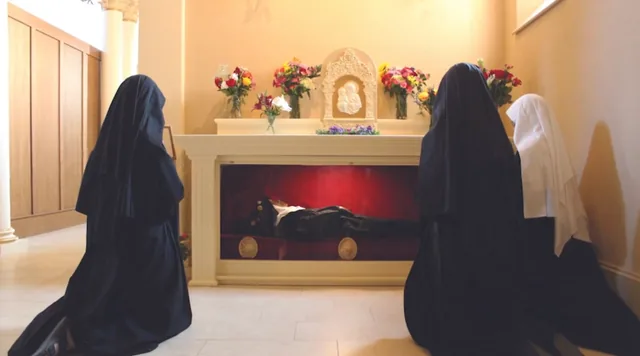
Fabriano’s diocese dates the transfer of his remains to 1481 and locates them in the crypt of Santi Biagio e Romualdo. That establishes the custodial account of location, not present anatomical condition. [5]
Valdicastro and Fabriano
Romuald died at Valdicastro in 1027 according to the diocesan account. It records the arrival of the body in Fabriano on 6 February 1481 and identifies him as a patron of the city and diocese. The municipality likewise locates his attributed remains at San Biagio rather than at the site where he died. [5][6]
Neither public description gives a current tissue inventory, treatment history or physical examination. The word “body” in a historical transfer account cannot by itself tell us how much soft tissue survives today. The evidence supports a history of veneration and custody while leaving the preservation claim materially unspecified. [5][6]
Camaldoli and Fabriano also represent different parts of the story. One preserves the living tradition associated with his foundations; the other keeps the attributed remains. A visit to either becomes more meaningful when the distinction is clear. [2][5]
READER QUESTIONS
Questions and answers
FOLLOW THE SOURCES
Sources and further reading
- Catholic Encyclopedia: Romuald, 1912
Historical account
Supports received family crisis, teachers, movements and attempted Hungary journey; birth chronology disputed and narrative attributed.
- Camaldoli Cultura: history
Religious institution’s account
Explains monastery/hermitage, hospitality and the different documentary bases for founding dates.
- Community of Camaldoli: Sacred Hermitage
Religious community’s account
Indexed text inspected; direct retrieval timed out. Describes laura, individual cells, prior, rule and shared prayer.
- Camaldolese nuns of Rome: little rule
Historical tradition in translation
Publishes transmitted short teaching on Psalms, attention and grace; no claim of an autograph or comprehensive constitutional code.
- Diocese of Fabriano-Matelica: patrons
Diocesan account
Indexed institutional text supports death and 1481 transfer/current crypt. No anatomical or treatment record.
- Municipality of Fabriano: Valdicastro
Local authority record
Corroborates Valdicastro history and attributed remains at San Biagio. No preservation examination.
Sources checked: 2026-10-27. Suggest a correction or a source.