THE PERSON BEHIND THE ACCOUNT
The brother whose reputation would not stay quiet
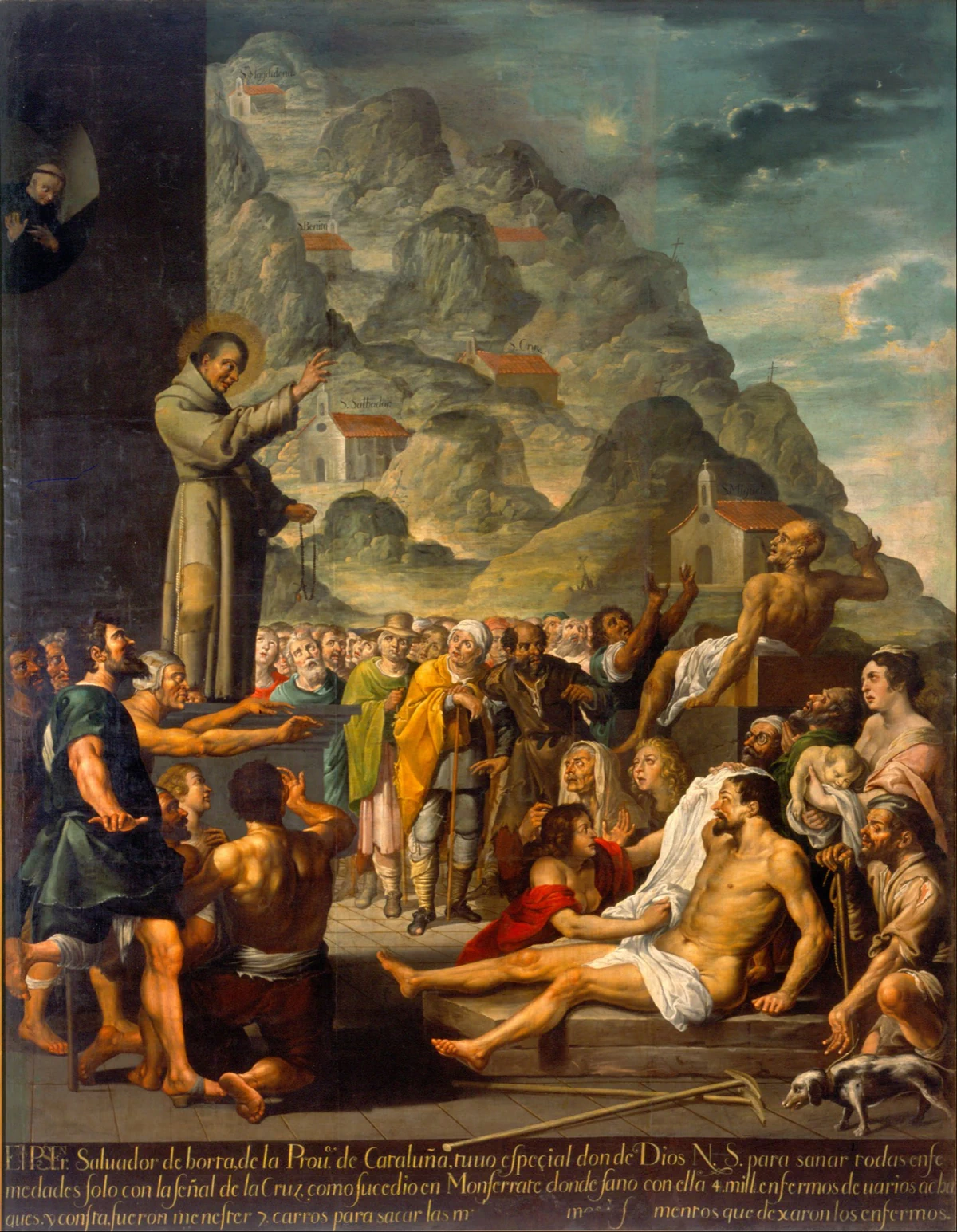
Salvador’s reputation created a practical problem for his communities. People came looking for a brother they believed could help them; superiors moved him between houses as the attention grew. His received biography is therefore a story about service under pressure, with neither fame nor obscurity entirely within his control. [1][2]
Choosing the Franciscans
Born in Catalonia in 1520 and orphaned young, Salvador tested his vocation at Montserrat, then entered the Franciscans in Barcelona and professed in 1542. The route involved choosing between forms of religious life. [1]
A Franciscan devotional biography adds an apprenticeship in shoemaking and remembers work assisting a cook, opening the door and collecting alms. Those details locate him among the tasks that kept a convent alive and brought a brother into contact with people outside it. [2]
At the door
The Franciscan biography remembers generosity toward visitors and a guardian concerned about the convent’s resources. Its dialogue is devotional storytelling. The tension between immediate need and finite resources remains recognizable without reproducing the conversation. [2]
The famous healing accounts grew around that everyday contact. The cause profile follows him through Tortosa and a succession of transfers before his arrival in Cagliari in 1565. Repeated moves form the documented institutional outline; the report does not give us a complete record of each dispute or every superior’s motives. [1]
Cagliari became his lasting home
Salvador spent his final period in Cagliari and died there in 1567. The church of Santa Rosalia now houses his relics. The municipal account records their position in a side chapel between 1844 and 1931, followed by placement at the high altar. The city’s continuing devotion belongs to this long local history. [1][5]
A Franciscan archival catalogue identifies a 1724 decree granting his Office and Mass. His canonization followed in 1938. These are dated acts of ecclesiastical recognition. [1][6]
IN OUR OWN LIVES
Useful work under unwanted attention
Salvador is worth reading beyond the catalogue of wonders. His story puts a brother doing ordinary work in the uncomfortable position of becoming a public attraction. It asks how a person and a community respond when other people’s expectations begin to determine the day. The history remains interesting without turning each healing narrative into a verified case report. [1][2]
THROUGH THE EYES OF FAITH
Faith and daily life
Cagliari’s diocesan liturgy remembers a religious brother who encouraged confession and Communion. It places the healing tradition within Catholic sacramental life and asks for patience in trials. He was not a physician or an ordained priest. [3]
Living with the crowds
The same narrative describes superiors concerned for Salvador and for peace in the cloister. Crowds and extraordinary claims created difficulties to judge; every restriction need not be explained as personal jealousy. [2]
The diocesan liturgical text gives a concise view of what people were meant to seek through his ministry: turning towards God through confession and the Eucharist. Its prayer remembers patience and healing as gifts of God. That is the religious interpretation of his work, separate from a medical assessment of any reported recovery. [3]
THROUGH THE LENS OF SCIENCE
The evidence about the remains
The diocese announced a canonical examination of his remains in 2016. The notice records an intended event and the archbishop’s presence; it contains no anatomical results. [4]
The announced examination
The 2016 diocesan notice announced a recognition of the body at Santa Rosalia on 19 October. It should be read as a notice of procedure. It gives no tissue inventory, treatment history or findings about natural preservation. No result can be supplied by assuming that a canonical recognition must have confirmed every popular description. [4]
The municipal history establishes changes in the setting of the relics; the older Franciscan biography repeats an intact-body report after an early opening of the tomb. These are different sources from different periods. Neither provides the current technical evidence needed to characterize all the remains as untreated preserved tissue. [2][5]
READER QUESTIONS
Questions and answers
Was Salvador a priest?
He was a professed Franciscan lay brother. The work and influence attributed to him did not depend on ordination. [1][2]
Did the 2016 notice establish that his body is naturally incorrupt?
No. It announced a canonical examination. It did not publish the examination’s results or a treatment history. [4]
FOLLOW THE SOURCES
Sources and further reading
- Dicastery for the Causes of Saints: Salvador
Church or shrine source
Supports Montserrat discernment, 1542 profession, transfers, 1565 Cagliari arrival and 1938 canonization. Header correctly names Pius XI; a Pius XII typo in body is not adopted.
- Directorio Franciscano: Edelvives life, 1964
Devotional history
Supports apprenticeship, convent jobs, crowds and received preservation story. Dialogue and healing stories remain hagiographical, not clinical documentation.
- Diocese of Cagliari: proper of Masses, 18 March
Liturgical record
Indexed text inspected; direct PDF retrieval 404. Supports brother’s humble offices, confession/Communion emphasis, relic location and liturgical prayer.
- Diocese of Cagliari: recognition notice, 2016
Diocesan account
Indexed notice announces 19 October 2016 examination; direct retrieval unavailable. It contains no anatomical results.
- Municipality of Cagliari: Santa Rosalia
Local authority record
Documents side-chapel custody 1844–1931 and later high-altar placement. No physical-preservation analysis.
- Franciscan Provincial Archive: 1724 liturgical decree
Archive record
Catalogue identifies a surviving 1724 printed decree granting office and Mass. Catalogue not used for any physical claim.
Sources checked: 2026-10-27. Suggest a correction or a source.