THE PERSON BEHIND THE ACCOUNT
A woman required to put an inner life into words
In 1693 Veronica Giuliani began the diary she had been ordered to keep. The record continued for decades. Writing demanded by religious authorities later became a route into the thought of a woman they were investigating. [1][2]
Orsola chooses the Capuchin Poor Clares
Born Orsola Giuliani at Mercatello in 1660, she entered the Capuchin Poor Clare monastery at Città di Castello in 1677 and took the name Veronica. The foundation’s biography describes her father pressing for marriage and her determination to follow the religious vocation. Entering therefore meant declining a family expectation as well as choosing a community. [3]
She spent the rest of her life in that monastery. Enclosure still contained a changing set of responsibilities: living with other women, forming novices and eventually serving as abbess. Her contribution cannot be read entirely through the extraordinary experiences for which the diary became famous. [1][2]
Scrutiny changed her daily life
The University of Chicago’s Italian Women Writers biography describes sharp conflict within the monastery and the 1697 referral of her case to the Holy See. The claims associated with her bodily and spiritual experiences were investigated. The record should not be simplified into a story in which every question was malicious or every account already proved. [2]
The diary emerged within that unequal setting. She had to describe inward experiences in language that confessors and authorities could assess. Its value includes her voice, but also the circumstances that shaped what she wrote. Readers are encountering a sustained religious account produced in response to a demand, not an unsupervised private journal. [1][2]
A teacher and an abbess
Veronica later became abbess in 1716 and remained in office until her death in 1727. The long interval between the famous 1697 events and that appointment matters. The community continued to live with her, and she continued to take responsibility within it. This was a fifty-year religious life, not one episode extended indefinitely. [1][3]
Monti records a practical achievement of her years as abbess: water was piped into the monastery for the sisters’ use. He also describes sound finances at her death. Enclosure contained infrastructure and shared resources as well as prayer; improving those conditions was part of governing other women’s lives. [5]
IN OUR OWN LIVES
Read a woman’s words before judging the spectacle
Veronica is worth approaching through the burden and achievement of writing. She produced a record that people in authority demanded, and later readers gained access to a woman’s intellectual and spiritual world through it. Her life also asks how a community can examine extraordinary claims while attending to the person making them. [1][2][5]
THROUGH THE EYES OF FAITH
Faith and daily life
Benedict XVI locates Veronica’s spirituality in Christ’s Passion and Resurrection, Scripture, liturgy and solidarity with others. Her teaching gives readers more to encounter than the unusual wounds associated with her name. [1]
What she meant by sharing suffering
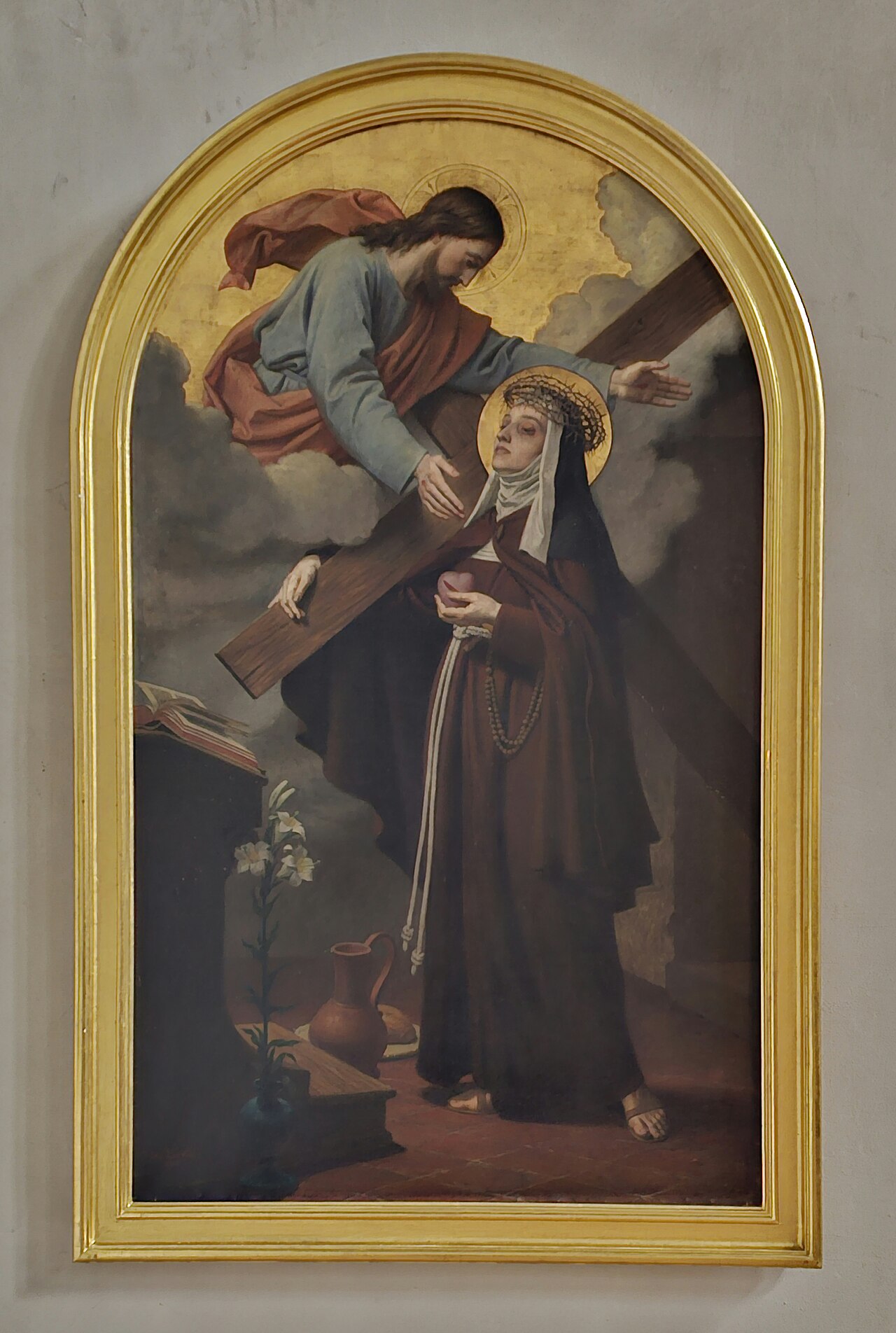
Benedict reads Veronica’s desire to share Christ’s Passion through love for other people and the Church. Paul’s words helped shape her account of belonging to Christ. The experiences belong within that theology. [1]
Her reported experiences can be studied through the language and relationships of this Catholic tradition without diagnosing her from a distance. Benedict’s account treats their purpose as love of Christ and service to others. [1]
THROUGH THE LENS OF SCIENCE
The evidence about the remains
Franciscan historian Dominic Monti reports that a flood destroyed Veronica’s formerly preserved body. Her bones are now held in a composite figure; he describes the heart as separately preserved. The display should not be called an intact body. [5]
The heart in the historical archive
Research presented through the Florence State Archive identifies early texts about Veronica, including a physician’s account and drawings interpreting features found in the corpse and heart as signs of Christ’s Passion. Those documents show how religious expectations and medical observation interacted after her death. [4]
The interpretation belongs to the authors of those records. No modern anatomical diagnosis is inferred here from their drawings or devotional descriptions. A historical observer reporting a sacred symbol is a different kind of evidence from a reproducible examination specifying tissue, method and possible alternatives. [4]
Monti’s account identifies a significant later change: a flood destroyed the preserved body, and bones now rest inside a composite figure. His description of a separately incorrupt heart remains an attributed condition claim. The foundation locates the shrine beneath the monastery church’s high altar; neither source supplies a complete current tissue or treatment inventory. [3][5]
READER QUESTIONS
Questions and answers
Is an intact body of Veronica on display?
Monti describes bones inside a composite figure after flood damage, with the heart kept separately. That is different from an intact whole body. [5]
Do historical drawings of her heart prove a miracle?
They document what early observers reported and how they interpreted it. They are not a modern independently assessed anatomical demonstration. [4]
FOLLOW THE SOURCES
Sources and further reading
- Benedict XVI: audience on Veronica, 2010
Church or shrine source
Diary, offices and scriptural, liturgical and communal aspects of spirituality. The English page’s 1893 canonization year is a typographical error; no claim here relies on it.
- University of Chicago: Italian Women Writers biography
University literary reference
Compelled writing, 1697 referral and conflict within the community; no retrospective medical diagnosis inferred.
- Veronica Giuliani Foundation: historical centenary
Religious institution’s account
Father’s pressure for marriage, 1677 entry, later leadership and shrine beneath the high altar. Same institutional history, not a technical condition report.
- Florence State Archive: Borgia on women’s monastic documents
Scholarly archival
Historical confessor and physician texts and drawings about corpse and heart; evidence of early interpretation of signs, not a new anatomical examination.
- Dominic Monti OFM: Saint Veronica Giuliani, CFIT, 7 July 2026
Franciscan scholarly
Verified byline Dominic Monti. Describes practical offices, piped water, finances, compelled diary and a flood-damaged body now represented by bones within a composite figure, with a separately preserved heart. Historical scholarly summary, not a published current forensic report.
Sources checked: 2026-10-27. Suggest a correction or a source.