THE PERSON BEHIND THE ACCOUNT
The nun who asked the Church to change
In the summer of 1586, a young enclosed nun in Florence dictated twelve letters calling for renewal in the Catholic Church. Their intended readers included the pope and cardinals. The letters to the pope and cardinals apparently never reached them. Mary Magdalene de’ Pazzi’s appeal survives anyway: a woman without public office insisting that the people who led the Church should live what they taught. [2]
A Florentine daughter enters Carmel
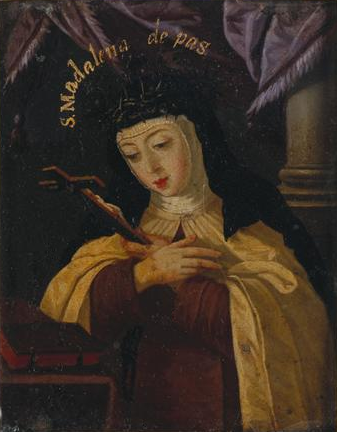
Born Caterina de’ Pazzi in 1566, she belonged to a noble Florentine family. Religious education and an early attachment to Communion preceded her decision to enter Santa Maria degli Angeli. She received the Carmelite habit and the name Mary Magdalene in 1583. The decision committed her to a particular community and its daily obligations, far from the social position her family could offer. [1][5]
During her novitiate she became dangerously ill. Because death seemed possible, she was permitted to make her profession early. She recovered. What followed included years of ordinary responsibility: assisting with novices, caring for the sacristy, directing novices herself and, eventually, serving as subprioress. These jobs required attention to other people and to the practical demands of shared worship. [5]
The sisters who wrote it down
Much of what is called her writing began as speech. Other nuns recorded her words during experiences they understood as ecstasies. The surviving corpus therefore has more than one human participant: Mary Magdalene speaking, companions listening and writing, and later editors arranging what had been preserved. Reading it as a modern private diary would miss that history. [3][4]
An early twentieth-century biography remembers both common sense and a strict approach to community discipline. Its admiring tone needs to be recognized, but its account also preserves a useful complication: the famous mystic had to govern, teach and live with people. The community did not experience her only through extraordinary prayer. [3]
IN OUR OWN LIVES
Begin with the novice mistress
Mary Magdalene is worth reading when religious feeling seems easier to admire than daily fidelity. Her surviving story includes ambitious appeals that barely circulated, responsibility for younger women and prayer that ceased to feel reassuring. The useful question is what held a life together through those changes. Her community’s answer was sustained love of Christ expressed in worship and service. [1][4][5]
THROUGH THE EYES OF FAITH
Faith and daily life
Her prayer grew from Scripture heard at Mass and in the Divine Office. In Carmelite scholar Míceál O’Neill’s reading, the words of the liturgy became the substance of her encounter with Christ, rather than a backdrop to unusual experiences. [4]
Twelve appeals, one known reply
The letters asked for conversion among clergy and religious. They were not a programme of administrative regulations; their recurring concerns were the conduct of leaders, the example they set and the redemption Christians professed through Christ. Their uncertain circulation matters. A forceful text is evidence of her convictions, not proof that it changed papal policy. [2]
The one intended recipient known to have read her letter was Catherine de’ Ricci. Catherine replied cautiously, advising consultation with a spiritual director. That exchange gives the story a welcome human scale: another experienced religious woman did not simply endorse every claim. Counsel and discernment belonged inside this world of intense devotion. [2]
When consolation disappeared
The years after her early mystical experiences included a prolonged period of spiritual trial. Benedict XVI’s account describes five years in which the felt assurance of grace was withdrawn. After that period she devoted herself particularly to forming younger sisters. Her last years brought further physical suffering before her death in 1607. [1]
O’Neill argues that the shorter periods of ecstasy have too often obscured the much longer life of religious observance. His study places her within the Eucharist, communal prayer, charity and suffering. That makes her spiritual teaching easier to approach: a reader can begin with how she listened and served, without pretending to share her experiences. [4]
THROUGH THE LENS OF SCIENCE
The evidence about the remains
A papal letter describes her body as incorrupt. That statement belongs to the record of Catholic veneration; the letter supplies no anatomical examination or conservation history. [1]
The body and the surviving record
Benedict XVI’s 2007 commemorative letter states that her body remained incorrupt and records her canonization in 1669. It is a significant official description, but it is not a report by anatomists. It gives no inventory of surviving tissue, account of treatments or explanation of preservation. Those particulars remain open in the sources inspected here. [1]
The manuscripts offer a different kind of evidence. They can be studied for language, transmission and theology; they cannot by themselves establish what caused an ecstasy or how a body was preserved. Keeping those questions separate allows her teaching and the physical claim to receive the kinds of attention each needs.
READER QUESTIONS
Questions and answers
Did she personally write all the works attributed to her?
Many surviving texts were recorded by other nuns from her spoken words. Their transmission is part of understanding the works, not a reason to treat them as a private autobiography. [3][4]
Did her letters reform the papacy?
The evidence supports her urgent desire for renewal. The Carmelite account says the letters to the pope and cardinals probably never left the enclosure; no direct policy effect is claimed here. [2]
FOLLOW THE SOURCES
Sources and further reading
- Benedict XVI: fourth centenary letter, 2007
Church or shrine source
Supports profession, trial, final illness, canonization and the official incorrupt-body wording. No anatomical or conservation report.
- Carmelite exhibition: the twelve letters
Religious order’s account
Explains dates, recipients, themes, limited circulation and Catherine de’ Ricci’s response; impact beyond the evidence is not asserted.
- Florence Capes, Catholic Encyclopedia, 1910
Historical account
Historical devotional biography describes community recording and government; supernatural accounts retain their attributed character.
- Míceál O’Neill: Contemplation and liturgy, 2022
Scholarly account
Carmelite scholarly study of liturgical sources, textual transmission and the balance of ecstasy with ordinary religious life; no medical diagnosis.
- Discalced Carmelites Nigeria: feast biography
Religious order’s account
Supports serious novice illness and successive practical community offices; reproduces a Carmelite liturgical biography.
Sources checked: 2026-10-27. Suggest a correction or a source.