

Open Genesis beside a diagram of the solar system's formation. In the diagram, a young Sun forms within a cloud of gas and dust; planets develop from the material around it. In Genesis 1, vegetation appears on the third day, while the great lights appear on the fourth. A reader who expects matching scientific sequences encounters a problem almost immediately.
The fruitful response begins with a reading question. What is Genesis doing with its sequence? Answering that requires attention to the text before trying to fit it around a scientific account. It also requires taking both Scripture and scientific evidence seriously enough to resist convenient shortcuts.
Notice the architecture
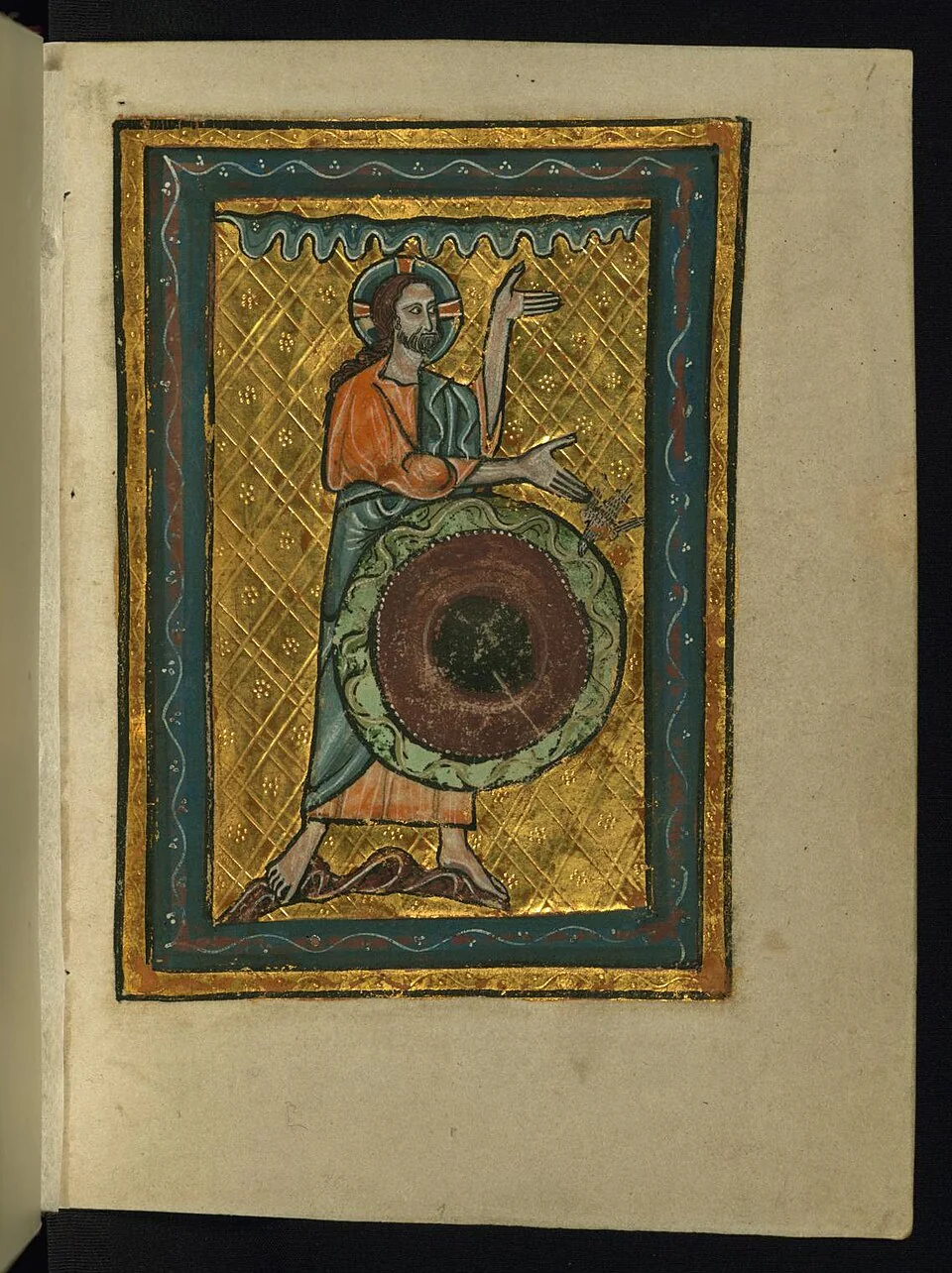
Genesis 1 repeatedly moves through divine speech, fulfillment, evaluation, and the marking of a day. Its first three days establish domains; the next three populate or govern those domains. Light and darkness correspond to the lights; sky and waters to birds and sea creatures; land and vegetation to land animals and people. The seventh day completes the movement with divine rest. The US bishops' biblical notes draw attention to this literary arrangement. Genesis 1 and its notes
That structure directs attention toward order, goodness, human responsibility, and worship. Counting the hours of each day does not exhaust what the passage is saying. Nor does recognizing a pattern make the text meaningless: an arranged narrative can make claims about reality through its arrangement.
The next chapter changes scale. Instead of surveying the cosmos, it attends to the human creature, a garden, work, relationship, and limits. Read the chapters consecutively and notice how the questions change. The second account's earthiness matters: people receive life, inhabit a place, and discover that solitude is insufficient. The text gives readers more to consider than a compressed timetable. Genesis 2
Literal meaning requires attention to genre
In ordinary reading, we do not treat a wedding vow, a weather report, and a laboratory protocol as interchangeable. Each can be truthful, but its assertions work differently. Calling a passage figurative is therefore the beginning of interpretation, not permission to believe anything we please about it.
The Second Vatican Council asks interpreters to investigate authorial intention, literary forms, historical circumstances, and customary ways of expression. It also requires attention to Scripture as a whole and the Church's tradition. These are complementary disciplines: historical study guards against projecting our expectations onto an ancient author, while theological reading asks how the passage functions within the faith that receives it. Dei Verbum, 12
A careful Catholic reader consequently has more work to do than choosing between “every detail is scientific chronology” and “none of it is true.” What is being asserted? Through what literary means? What would a proposed interpretation do to the rest of Scripture? A good interpretation must answer those questions with reasons, rather than merely escape an uncomfortable finding.
What scientific accounts actually contribute
Consider the age of the universe. Astronomers use observations of expansion, stars, and the early universe to reconstruct a physical history. The estimate of roughly 13.8 billion years belongs to that evidential enterprise. It does not come from translating a biblical word into a larger unit of time. NASA's overview explains the scientific setting of this estimate and distinguishes the universe's history from the much younger history of Earth. NASA: What is the Universe?
This makes a popular reconciliation tempting but fragile: perhaps each biblical day secretly denotes one geological or cosmological age. Yet a proposed correspondence must survive both textual scrutiny and the actual sequence of events. Moving the boundaries whenever a mismatch appears produces an interpretation that no evidence could correct. It may also distract from the text's deliberate rhythm and culmination.
Scientific explanations have their own limits, but those limits should be identified specifically. An account of how a planet formed does not by itself determine whether its existence is a gift. Conversely, believing that creation is a gift does not predict the chemical composition of its rocks. These questions concern the same world while asking different things about it.
Creation is more than an opening event
Within Catholic theology, creation includes the dependence of everything on God. The Catechism presents the Creator as sustaining creatures in existence. A long, intelligible physical history can therefore remain a created history throughout. Catechism, 300–301
This distinction has practical force. If a child learns why rain falls, the new explanation need not subtract rain from creation. It gives the child a better understanding of something within creation. The theological question concerns the existence and significance of a world capable of such processes, as well as the human responsibilities that follow within it.
Still, “different questions” must not become a shield against every possible conflict. A religious interpretation that asserts a young physical Earth makes an empirical claim. Evidence bears on it. A scientific writer who says that evolutionary history proves human life has no purpose has likewise added a philosophical conclusion requiring its own defense.
The difficult chapters remain difficult
Genesis also speaks of wrongdoing, estrangement, and the beginnings of humanity. Catholic teaching does not allow all those claims to dissolve into a general observation that people sometimes behave badly. The Catechism describes the Fall as conveyed figuratively while affirming a primeval human event. In Humani Generis 37, Pius XII explicitly restricted polygenism because of its relationship to original sin. Interpreting literary form does not automatically resolve those questions. Catechism, 390; Humani Generis, 37
A workable reading practice is to keep three notes beside the page: what the passage emphasizes, what the relevant science establishes, and what further theological question remains. The notes should become more precise with study. Uncertainty about one connection need not erase everything learned in the other two columns.
Return, finally, to the seventh day. A timeline alone cannot tell us why rest belongs in a vision of a good creation. Genesis makes the reader confront a world that is received before it is used, and human beings whose worth exceeds their productivity. Those claims deserve sustained attention alongside, and beyond, the question of how long the world took to form.