
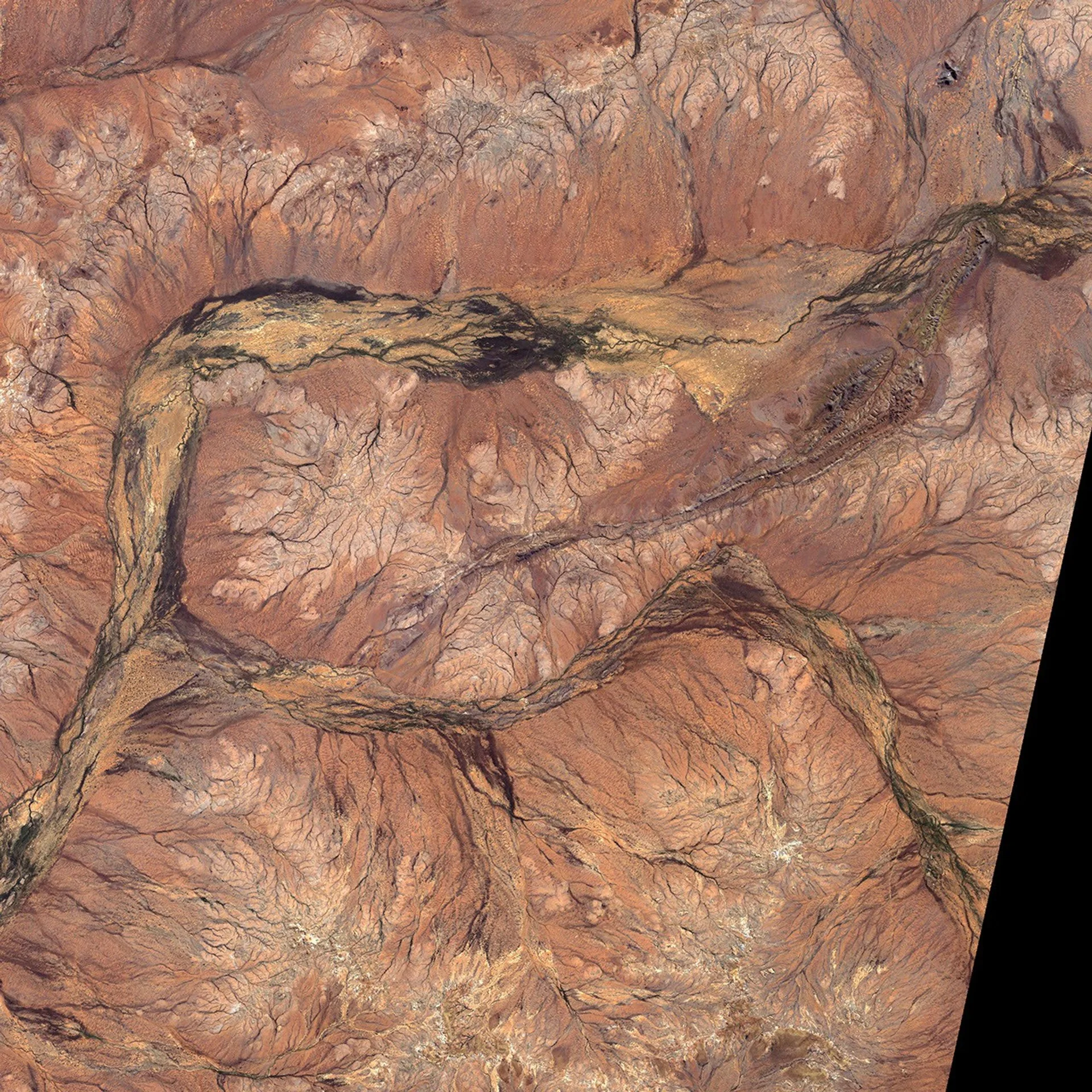
A grain of zircon can be smaller than a grain of sand and older than every mountain range visible from your window. Some zircons from Western Australia formed about 4.4 billion years ago. Their value is not that they look ancient. It is that atoms inside them preserve information that researchers can measure. A 2014 study even investigated the distribution of individual atoms to test whether movement of lead could have spoiled one exceptionally old grain's age. Valley and colleagues' research abstract
Earth itself is older still: about 4.54 billion years. That number is not obtained by counting backward through a fossil catalogue or assigning an age because evolution requires it. It emerges from physical measurements interpreted within the history of our planet and solar system. USGS on geological time
A clock made of atoms
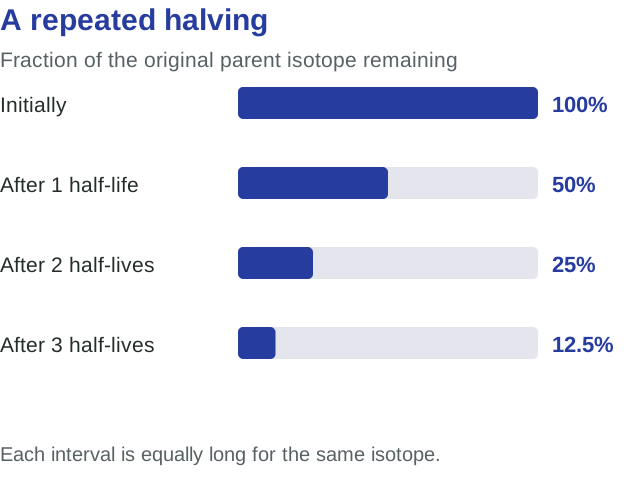
Isotopes are forms of an element with different numbers of neutrons in their nuclei. Some are unstable and change into other isotopes through radioactive decay. For a large population, the rate follows a predictable pattern. A half-life is the time in which half the original radioactive atoms decay; another half-life removes half the remainder, leaving one quarter.
Uranium offers clocks suitable for very old minerals. Uranium-238 eventually produces lead-206, with a half-life of roughly 4.5 billion years. Uranium-235 produces lead-207 on a shorter timescale, about 704 million years. Measuring parent and daughter isotopes allows geologists to infer elapsed time, provided the mineral's history and starting composition are properly accounted for. National Park Service explanation of radiometric dating
Imagine a large, sealed sample represented by 100 units of parent isotope. When 50 units remain, the ideal decay model indicates one half-life has elapsed, assuming there were no daughters initially and nothing entered or escaped. Real laboratories measure vast populations, trace contamination, use standards, and choose methods suited to the material. The classroom arithmetic explains the principle; it does not replace the laboratory work.
Carbon dating serves a different range. Carbon-14's much shorter half-life makes it useful for relatively recent organic remains, generally extending to tens of thousands of years. It is not the clock used to date Earth's formation. An objection about carbon in a sample therefore needs to be evaluated as an objection to that particular measurement, not automatically to every radiometric method. NPS's comparison of isotope systems
First ask what event the clock records
“How old is this rock?” can hide several questions. When did its minerals crystallize? When did heat alter them? When did a river deposit grains eroded from a much older rock? Those events may have different dates.
The National Park Service's account of Grand Canyon geology explains how researchers connect an age to an event. A volcanic ash layer deposited among sediments can date part of a sedimentary sequence. A younger intrusion cutting through older layers establishes a different limit. A transported zircon may be much older than the sandstone in which it now sits. Geologic dating techniques at Grand Canyon
A precise laboratory number can answer the wrong question if the sample's setting is misunderstood. Geologists combine measurements with relationships among layers and minerals. The result depends on understanding both the sample and its surroundings.
The assumptions are investigated
Dating requires reliable decay rates, an appropriate account of initial daughter isotopes, and understanding of whether later events moved relevant atoms. These are real conditions. A broken or altered mineral can produce a misleading age.
Different isotope systems, separate minerals, and the sequence of geological events provide checks. In uranium–lead work, the two decay chains offer an especially useful comparison. The 2014 zircon study went further, mapping individual atoms to investigate lead that had moved during a later heating event. The lead was concentrated in clusters about ten nanometers across. That movement sounds fatal to a clock based on lead, but its scale was crucial: the authors found that redistribution within these tiny clusters could not bias the grain’s measured uranium–lead age. The question was how far the atoms had moved, rather than simply whether they had moved at all. Valley and colleagues’ research abstract
A date that disagrees with the surrounding geology sends researchers back to the sample: was the mineral reheated, did atoms escape, or was an older grain carried into younger sediment? The answer may explain a particular discrepancy. A competing account of Earth’s age also has to explain why other minerals, isotope systems, and geological sequences agree.
Why meteorites help date Earth
Earth continually changes its surface. Erosion, melting, burial, and tectonic activity destroy or alter ancient records. The oldest surviving terrestrial mineral therefore gives a minimum age for the planet, not its birthday.
Meteorites preserve material from the solar system's early history. In 1956, Clair Patterson used lead isotope measurements associated with meteorites to establish an age near 4.55 billion years. Subsequent work refined the chronology. These samples matter because they belong to the same planetary formation story while often preserving earlier records more successfully than Earth's active crust. USGS's account of Patterson and subsequent dating
Earth grew through a sequence of events. An age of approximately 4.54 billion years places that formation within a well-supported chronology; it does not assign the whole planet a single moment of crystallization. The remaining questions concern the sequence and timing of those events, within a history measured in billions of years.
Reading an ancient world faithfully
For a Catholic reader, the length of this history may initially unsettle a familiar mental picture of Genesis. The Church's guidance on interpretation calls for attention to literary form, authors' intentions, and historical context. That demands careful reading; it is not permission to dismiss whatever a text makes inconvenient. Vatican II, Dei Verbum, paragraph 12
The Catechism explicitly welcomes scientific work illuminating the age of the cosmos and the development of living things. Geological investigation is therefore no betrayal of the conviction that the world is created. Catechism, paragraph 283
For any quoted age, ask which event the measurement dates. Then look for measurements of other materials that can test the interpretation. The age of a crystal, the formation of a rock, and the age of Earth are related questions with different evidence.