
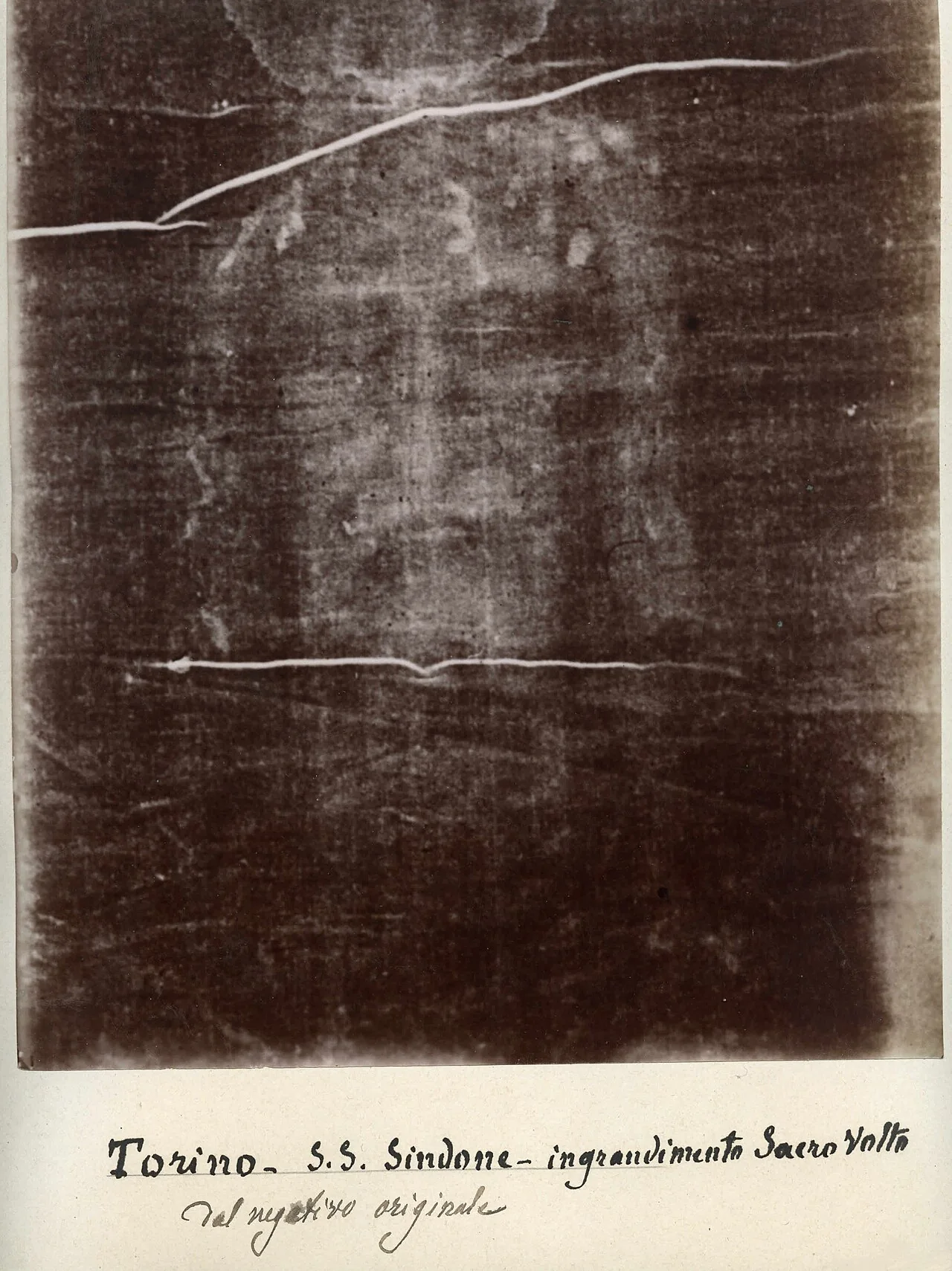

In 1898, Secondo Pia photographed the Shroud of Turin, a linen cloth bearing front and back images of a man who appears to have been whipped and crucified. The image’s resemblance to a photographic negative drew modern scientific attention to an object already surrounded by devotion. For someone who believes it wrapped Jesus’ body, the cloth seems to bring the Passion within reach of a camera and a laboratory. The original radiocarbon report recounts this history.
But “is it real?” bundles together several investigations. Dating flax fibers, explaining an image and identifying the person depicted require different evidence. A first-century textile would still need a historical connection to Jesus; an unexplained image would still need an explanation. Keeping those questions separate lets us see what each result changes.
What the radiocarbon result says
In 1988, laboratories in Arizona, Oxford, and Zurich tested pieces from a sample taken from one corner of the Shroud. The paper appeared in Nature in 1989. Its authors reported a calibrated date range of AD 1260–1390 at at least 95 percent confidence, supporting a medieval origin for the sampled linen. Damon and colleagues' original report describes both the sample and the procedures.
Radiocarbon dating estimates when a plant stopped exchanging carbon with its environment; for linen, it concerns the flax used to make the fibers. It does not directly date the image or identify a person. Three laboratories supplied valuable independent measurements, but they did not sample three widely separated parts of the whole cloth. The remains once attributed to Blessed Idesbald offer another example of dating and identity coming apart: tests placed them centuries after his death.
A first-century identification has to explain why the sampled linen produced a medieval radiocarbon result.
The laboratories also dated three comparison textiles with independently established ages. They subdivided and cleaned specimens in different ways to address possible contamination; the paper reported no significant differences between the cleaning procedures within each laboratory. Full blinding was impractical because the Shroud’s weave was distinctive. The laboratories agreed to submit results before comparing them, and Oxford and Zurich recoded material before the final measurements. These controls help explain why the dating carries weight, while leaving the choice of sampling location open to challenge. Sampling, controls and measurement procedures
What the statistical challenge changes
In 2019, Tristan Casabianca and colleagues reanalyzed raw radiocarbon data obtained from the British Museum. They challenged the homogeneity of the measurements and argued that the original combined confidence interval deserved reconsideration. This is an issue about whether the observations can legitimately be treated as one uniform sample population. Their Archaeometry paper gives the statistical argument.
But the authors also state that each individual raw or published radiocarbon date points to a medieval interval. Heterogeneity does not, by itself, move the cloth into the first century. It raises questions about sampling, measurement variation, and how results should be combined.
The resulting question is how wide an interval the measurements justify and whether variation across the sampled strip needs an explanation. The reanalysis supplies a reason to revisit the combination of results, while its individual dates remain medieval.
Was the sample an unrepresentative repair?
A different challenge concerns the material itself. In 2005, Raymond Rogers reported chemical differences between fibers associated with the radiocarbon sampling region and fibers from other parts of the Shroud. He argued that the dated region was not representative, invoking evidence of substances and fibers associated with a repair. His Thermochimica Acta paper makes a material claim, rather than merely a statistical objection.
That hypothesis requires attention to the provenance of the threads examined and to how representative they are. It also faces contrary evidence. Rachel Freer-Waters and A. J. Timothy Jull studied a retained piece from the Arizona sample and reported no evidence for dyes, coatings, or reweaving that would support such a repair. Their microscopy did identify minor extraneous material; the point was not that the specimen was perfectly pure. Their 2010 Radiocarbon paper directly challenges a confident claim that the dated sample has been proved to be a replacement patch.
Neither examination surveys every part of the cloth. Together, they show why the repair explanation remains disputed. It cannot simply be asserted as an established fact that invalidates all three laboratories' measurements.
The X-ray estimate and its assumptions
In 2022, Liberato De Caro and colleagues used wide-angle X-ray scattering to examine structural degradation in a tiny linen sample. They reported compatibility with an approximately two-thousand-year age under specified assumptions about the temperature and humidity experienced during the cloth's undocumented history. Their Heritage paper explains those conditions and calls for further measurements. Its roughly two-thousand-year interpretation assumes average temperatures of 20–22.5°C with corresponding relative humidity of 75–55% over thirteen undocumented centuries. Those are conditions in the age model, rather than a recovered record of where the cloth was kept.
This is an indirect aging inference. Environmental history affects the relationship between degradation and time, so assumed storage conditions matter to the age obtained. Compatibility with a first-century age under those assumptions is not a direct, independent radiocarbon date for the whole Shroud. The ancient comparison textile mentioned in the study must not be confused with an independently established date for the Shroud sample itself.
A useful next test would ask whether the age estimate survives better-constrained environmental assumptions and measurements from documented locations on the cloth. Conservation expertise would be essential: obtaining a more representative set of measurements has to be weighed against damage to a unique object.
What faith asks of the investigation
John Paul II addressed the question directly during his 1998 visit. He said that authenticity was not a matter of faith and that the Church did not have specific competence to pronounce on that scientific question. He encouraged investigation while reflecting on the cloth as a prompt to contemplate Christ's suffering. His address is not a Vatican certification that the Shroud is Jesus' burial cloth.
John Paul also asked believers to see the suffering of contemporary people in the image: victims of war, torture, exploitation and poverty. His reflection gave devotion a practical direction toward people whose suffering could be ignored. That religious use of the image makes no laboratory verdict about its age. His reflection on human suffering
On the dating evidence considered here, the medieval radiocarbon result retains substantially greater weight than claims that a first-century origin has now been established. A reader following the next announcement can ask one precise question: has it produced a better-supported date for the linen, or addressed another part of the puzzle? The image, its history and its devotional use will still need their own accounts.