
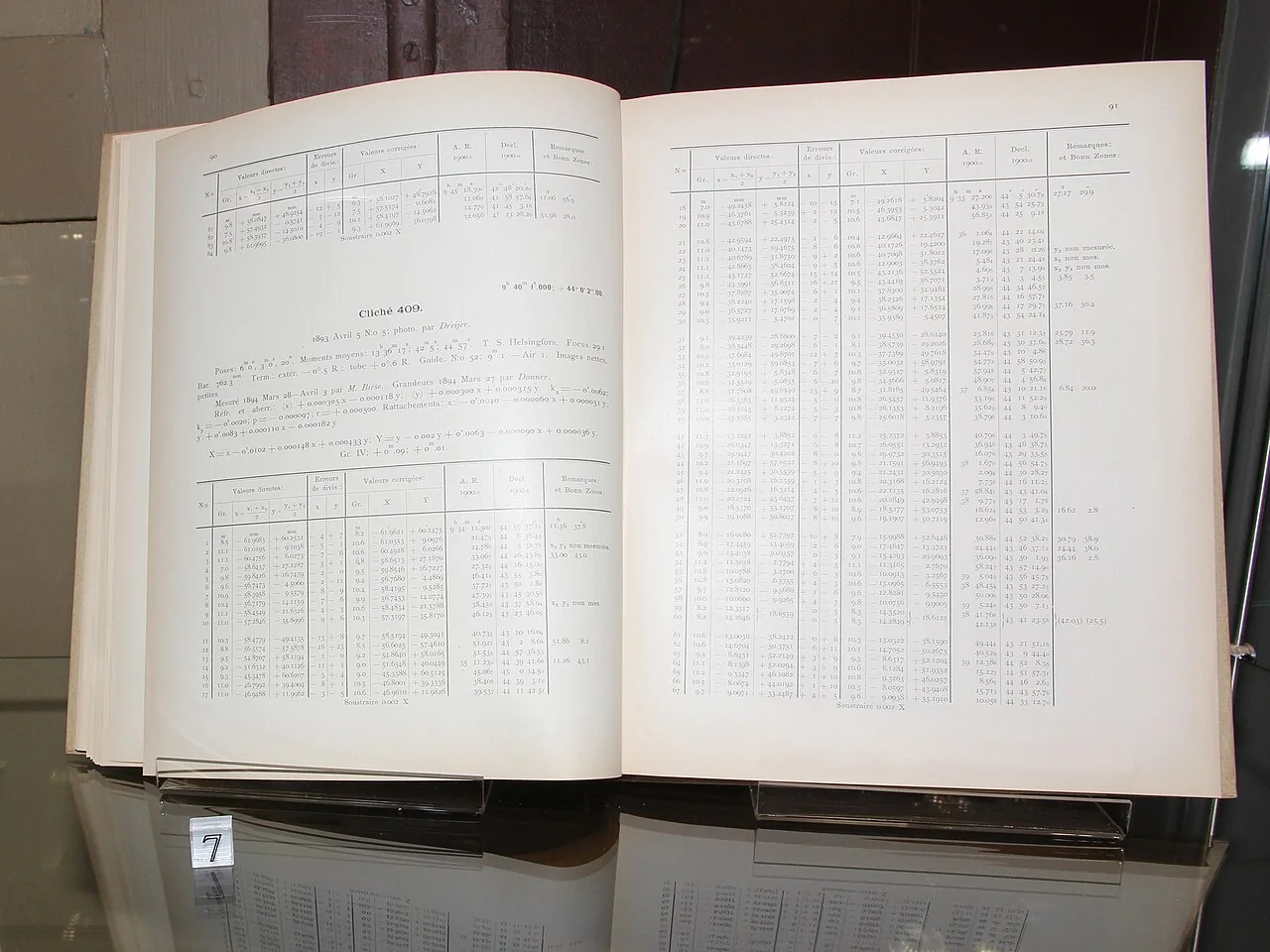

A photographic plate preserves a patch of sky as a field of tiny images. To a casual viewer, it may look like a finished scientific result. To the people building a star catalogue, it is the beginning of a much longer job. Each useful image must be measured, recorded, checked, and connected to a system of coordinates.
In the early twentieth century, four women from the Sisters of the Holy Child Mary contributed to that work at the Vatican Observatory: Emilia Ponzoni, Regina Colombo, Concetta Finardi, and Luigia Panceri. Their names belong beside the instruments and directors in the story of the Observatory's participation in an international effort to map the sky. The Observatory's account naming the four sisters.
The women’s measurements attracted praise from Oxford. Yet the letter thanking them did not name all of them. Their history includes both scientific recognition and the incompleteness of the record.
Two related ambitions
The international Carte du Ciel undertaking involved a photographic chart and an associated Astrographic Catalogue. These were related products with different demands. A chart reproduced an arrangement of stellar images; a catalogue provided numerical measurements that could be used in calculations and comparisons. Participating observatories took responsibility for particular sky zones. The detailed history of the Vatican contribution.
The distinction prevents a misleading compressed chronology. The Vatican catalogue appeared in ten volumes between 1914 and 1928. Work on the separate photographic chart continued much later. The sisters' plate measurements were part of the catalogue's production, not evidence that the entire international sky-mapping ambition was finished in the same period.
Repeated exposures, with the telescope shifted slightly, produced several images of each star. A flaw in the photographic material would lack that pattern. Measurement began by distinguishing a star from a mark on the glass. The exposure scheme.
From glass to coordinates
Under director Johann Georg Hagen, the Observatory obtained specialized measuring instruments from the Repsold firm. A microscope and movable plate holder allowed an operator to locate stellar images against a fine grid and record positions in two directions. The official history documents sisters performing measurements between 1910 and 1921; the individual dates of service are not given for all four women. The measuring program.
The basic distinction is between a position on a plate and a position on the sky. A plate has edges and measurable distances. The sky is described by angular coordinates. To connect the two, astronomers need reference stars with known positions and a mathematical account of how the telescope projected the field onto the plate.
Imagine marking several familiar landmarks on a photograph of a town. Their known positions help determine where an unfamiliar building lies. In astrometry—the precise measurement of celestial positions—the operation is more exacting. Instrumental geometry, distortions, and the reference system all matter. The plate measurement is indispensable, but it is not the whole calculation.
The Vatican program's subsequent coordinate calculations involved Oxford Observatory under Herbert Hall Turner. The finished catalogue listed positions and brightnesses for 481,215 stars. The institutional history describes repeated measurements with plates reversed, a procedure that helped expose errors associated with measurement orientation. The catalogue's production and checks.
Why old positions can become new evidence
Stars do not remain fixed relative to one another. Their apparent positions change because they move through space, although most changes are too small to notice by ordinary viewing. The component across our line of sight is called proper motion. Measuring it requires positions separated in time. The European Space Agency's explanation.
A long time interval can make a small motion easier to distinguish. As an illustrative calculation, a star moving by one tenth of an arcsecond each year changes position by ten arcseconds over a century. An arcsecond is one three-thousand-six-hundredth of a degree. The example is not a claim about the accuracy of every historical measurement; it explains why dates are part of astronomical data.
The Tycho-2 catalogue, released in 2000, combined satellite-era positions with older ground-based catalogues, including the Astrographic Catalogue, to derive proper motions. NASA's archive documents that combination. The Tycho-2 catalogue description.
The original research paper also discusses the use of these older observations and the catalogue's limitations. Old data are not automatically good data: they need calibration, error assessment, and a compatible reference frame. But preservation can allow a measurement to answer a question its original makers could not fully anticipate. Høg and colleagues' Tycho-2 paper.
Remembering the workers accurately
In 1921, Oxford’s Herbert Hall Turner praised the work’s care and asked that Sister Emilia and her colleagues be thanked. He knew them through their work, he wrote, rather than by their names. He also recognized their congregation’s commitment of time to astronomy. The letter, reproduced in the institutional history.
The measurements were detailed enough for distant collaborators to trust while the women’s names remained less securely recorded. Naming them helps correct that imbalance. Individual roles still have to be bounded by what the documents actually tell us.
Their religious vocation also matters without licensing imagined thoughts. The congregation made their labor available to an astronomical undertaking. We do not have to invent prayers at an eyepiece or private reflections on particular stars to recognize a concrete contribution by Catholic women to scientific knowledge.
The dignity of a careful record
A catalogue is an act of trust across time. Its makers ask future readers to rely on measurements they did not witness. That trust is earned through records, checks, and methods that make mistakes discoverable. It also depends on institutions preserving the work and remembering whose skill produced it.
Read the catalogue for its measurements and Turner’s letter for the people behind them. The numbers and the names each preserve part of the undertaking.