
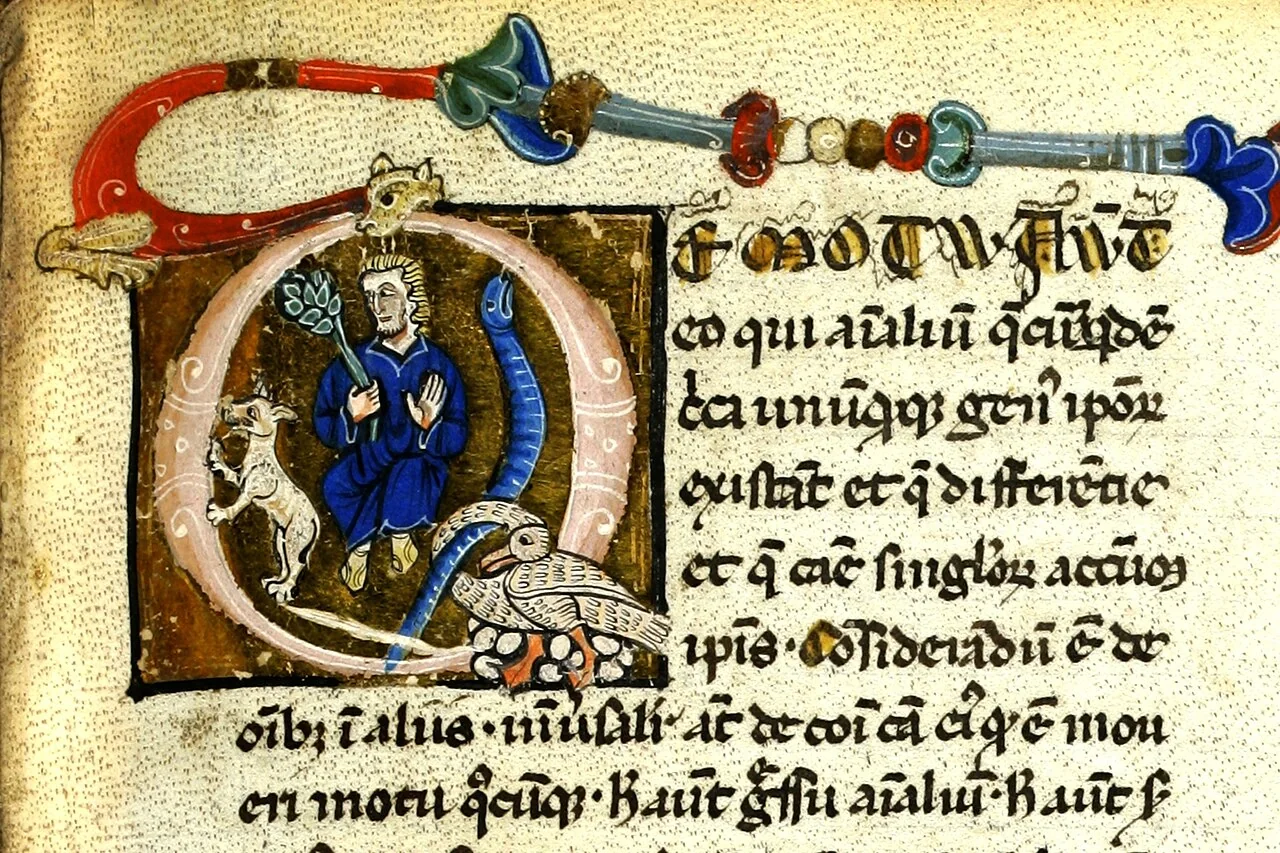

Albert the Great describes a plant growing on a tree’s branches, its leaves vigorous in winter, its berries white. The particulars sit beside attempts to explain how one plant grows on another. His De vegetabilibus et plantis brings recognizable living things into a thirteenth-century account of nature.
The Dominican friar wrote about plants, animals, minerals, and many other subjects while also teaching philosophy and theology. He became a saint and a Doctor of the Church. His interest in nature was extensive enough that later generations remembered him as a universal doctor: a scholar whose curiosity ranged across the kinds of knowledge available to him. Benedict XVI's account of Albert.
His botany explains growth through heat, moisture and the traditional elements. Its descriptions and its causal explanations need to be examined separately.
A world organized differently
Albert's natural philosophy included subjects now distributed among several departments. Questions about motion, life, the soul, physical materials, and causation belonged within an interconnected investigation of nature. Aristotle supplied a major framework, but Albert's project also involved explanation, supplementation, and engagement with other traditions of learning. The Stanford Encyclopedia's scholarly study.
This was not simply the memorization of an ancient author's conclusions. Albert wanted to make a large body of thought intelligible to his contemporaries, including his Dominican brothers. His work brought difficult questions into an organized curriculum. Yet it also retained assumptions about elements, change, and the heavens that later science would substantially revise.
Albert’s readers were gaining access to Greek and Arabic learning through Latin translations. His sources included the Muslim philosophers Avicenna and Averroes as well as Aristotle. He used them to develop a Christian intellectual project; that project depended on knowledge preserved and developed beyond Christian Europe. The scholarly account of his sources and project.
Beyond repeating what a book says
The older Catholic Encyclopedia preserves references to passages in Albert's writings on minerals and plants in which he insists on investigating natural causes and gives experience an important role. Those passages should be read with care: a medieval term translated as “experiment” does not automatically mean a controlled experiment in the present sense. Nevertheless, they show why a picture of Albert as interested only in authoritative texts is inadequate. The encyclopedia's discussion and work references.
In the passage on one plant growing on another, Albert distinguishes their forms and records leaves and berries. Those particulars can be checked even where his explanation of the plant’s origin goes wrong. A useful description can outlast its accompanying theory.
For a student of nature, that is a demanding habit. Keep the report precise enough that another person can recognize the thing. Then ask separately whether the proposed cause accounts for it. A persuasive description can otherwise lend undeserved authority to a weak explanation.
Observation is skilled work
Looking is not an empty-minded act. A person who knows a plant well notices structures that another person overlooks. Knowledge directs attention, provides names, and suggests comparisons. It can also make an observer see what an established theory leads them to expect. Scientific observation therefore needs procedures that expose a judgment to checking. The relationship between observation and theory.
A useful notebook records the date, circumstances, and limits of an observation. It separates what was seen from what was inferred. If a bird visits a plant, we still need to find out whether it eats the seeds, shelters among the branches, or searches for insects. Another observation may distinguish those possibilities.
Albert's writings belong to a world in which personal experience, inherited reports, and broad philosophical principles were combined differently from today's research. Scholarship recognizes his interest in particular observations while warning against portraying him as already practicing the full mathematical and experimental methods of modern science. The historical distinction.
Albert’s work gives us something better to examine than a claim that a saint anticipated modern science: descriptions, arguments and inherited assumptions whose strengths can be distinguished. His errors remain part of that record.
Why a saint would care about particulars
For a Catholic, creation is not valuable only when it can be turned into an argument. The Catechism teaches that creatures possess their own goodness and perfection, and that their differences and interdependence deserve respect. A tree's significance is not exhausted by its usefulness to a person or by the religious symbolism someone assigns to it. Catechism, paragraphs 339–341.
That gives attentive inquiry a moral and spiritual dimension. To understand a creature more accurately can be a way of receiving it more gratefully. It also corrects self-centered habits: the world does not exist simply to provide convenient illustrations for ideas we already hold.
Benedict XVI presented Albert's scientific interests as compatible with a path of holiness, while explicitly distinguishing his methods from those established in later centuries. Albert was canonized and declared a Doctor of the Church in 1931; Pius XII later named him a patron of the natural sciences. These honors concern a life and vocation. They do not make each proposition in his natural philosophy authoritative science. The papal audience.
A practice worth inheriting
We can begin modestly: choose a familiar natural object and describe it precisely before explaining it. Notice what remains unknown. Consult someone who can distinguish the features that matter. Return to the object and see whether the new knowledge changes what becomes visible.
The point is to acquire something solid enough to revise. A leaf drawing may omit the arrangement of the veins; a second look can correct it. A name learned from a field guide may reveal that two apparently identical plants differ. Attention becomes more useful when we leave a record of what we thought we saw.
Albert’s book can be approached in the same spirit. Follow one description into the world, compare it with a living plant, and see where the explanation outruns the observation. The saint and the reader are both answerable to the particulars.