
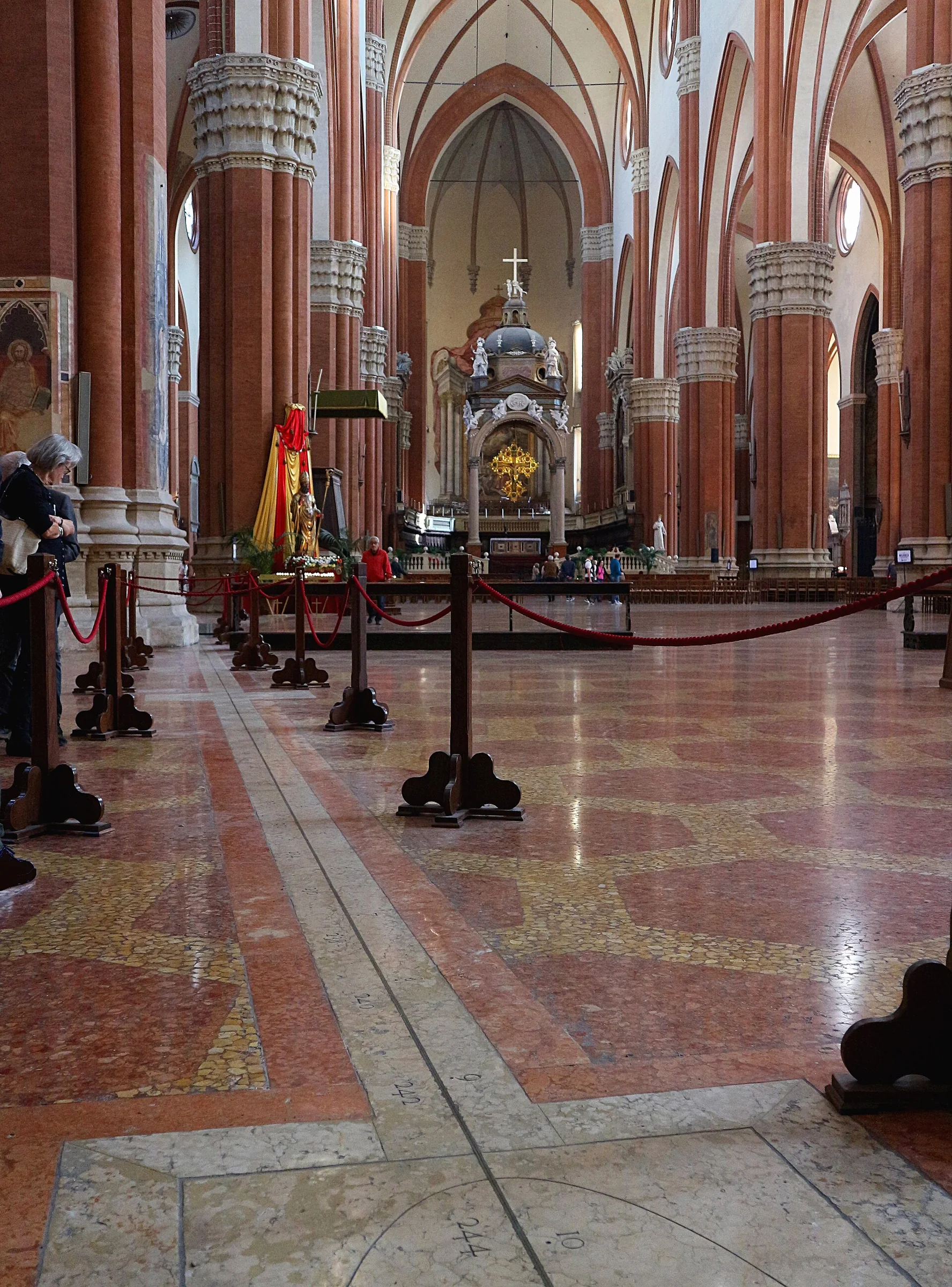

An astronomical instrument need not look like a telescope. Inside the Basilica of San Petronio in Bologna, it takes the form of a small opening high in the building and a long line set into the floor. Sunlight enters through the opening and projects an image that crosses the line around local solar noon. The church itself provides the scale and shelter required for the measurement.
Giovanni Domenico Cassini built this meridian instrument in 1655. The University of Bologna records a public demonstration that September, when observers were invited to see it working. The surviving line turns a place associated with worship into a visible record of astronomical inquiry. The university's account of the 1655 demonstration.
Its purpose went beyond telling people that midday had arrived. With careful geometry and repeated observations, it could help investigate the calendar and the apparent motion of the Sun.
How a hole becomes an instrument
The opening acts like the aperture of a pinhole camera. Light traveling from different parts of the Sun passes through it and reaches different places on the floor, forming a solar image. There is no need to aim a lens at the Sun. The building remains fixed while the Sun's apparent position changes.
The meridian line follows a north–south direction. When the Sun crosses the local meridian, its projected image reaches the line. Where it lands depends on the Sun's height in the sky. In summer the noon Sun is higher; in winter it is lower, sending the image farther from the point directly beneath the aperture.
Cassini's instrument used an opening roughly 27 metres above the floor and a line nearly 67 metres long. A tall building therefore provided a large measuring scale: a small change in angle could become a more manageable difference in position. The University of Bologna's description of the instrument.
Size alone did not guarantee accuracy. The opening's position, the floor's geometry, and the line's orientation all required attention. A movement in the building could imitate a movement in the sky. The observer had to understand the apparatus as well as the Sun.
A calendar is a model of the sky
The Gregorian calendar had been introduced in 1582 to correct the accumulating mismatch between the calendar year and the seasons. Easter's calculation made the seasonal placement of the equinox especially important to the Church. Calendar reform was thus one place where a religious need depended on astronomical knowledge. The Vatican Observatory's account of astronomy and calendars.
A calendar turns continuous natural cycles into a manageable set of numbered days. The difficulty is that the cycles do not fit together in whole numbers. A year is not an exact number of days, and the sequence of lunar phases does not divide the year neatly. Rules about leap days and ecclesiastical lunar calculations are ways of maintaining a workable correspondence.
The meridian could help check that correspondence by tracking the Sun through the year. This was not a new calendar reform. It was a way to examine the astronomical basis of an existing arrangement with an instrument capable of more precise work.
That distinction helps explain why usefulness and curiosity can share an instrument. A project funded for one recognizable purpose can produce measurements relevant to deeper questions.
The changing size of the Sun
The projected solar image also allowed observers to estimate the Sun's apparent diameter. An object of constant physical size looks larger when nearer and smaller when farther away. If the Sun's apparent diameter changes during the year, that supplies information about changes in the Earth–Sun distance.
Cassini compared such changes with the variation in the Sun's apparent progress along its annual path. The University of Bologna's museum history describes observations supporting nonuniform orbital motion consistent with Kepler's laws. The important comparison involved both angular size and motion, rather than a single picturesque spot of sunlight. The museum's historical account.
A simple analogy clarifies the logic. If a nearby vehicle seems to sweep across your view faster than a distant one, geometry may explain some of the difference without any change in its actual speed. To distinguish geometry from physical acceleration, you need information about distance as well as apparent movement. Cassini's solar measurements allowed a related question to be approached quantitatively.
This did not, by itself, settle every dispute about whether Earth moved. The measured relative motions could be described within different arrangements. The university's modern account explicitly notes that Cassini did not make a direct public declaration of heliocentrism on this basis. Precision about what a measurement establishes is part of appreciating it.
A church with a complicated scientific history
The setting should not be turned into a simple advertisement for uninterrupted harmony. Galileo had been condemned only a little more than two decades before Cassini built the instrument. Catholic institutions could support particular observations while restrictions on cosmological claims remained. The museum places Bologna's research within that mixed intellectual and political environment. The broader Bolognese context.
Nor does the instrument imply that Christian belief can be read directly from a solar image. Its religious connection lies in a place, a calendar, institutions, and the people who found reasons to support the work. The measurement itself must be assessed through geometry and observation.
The physical setting nevertheless remains remarkable. A building intended for communal worship also made sustained investigation possible. Architecture became equipment, and the same returning sunlight could be encountered as part of a liturgical day and as material for a calculation.
A record that outlasts a noon
The University of Bologna's astronomical archive lists observations and calculations associated with the San Petronio meridian and later observers. The descriptions record work on solar transits, apparent diameter, and other astronomical quantities. A historical instrument's contribution resides not only in its survival but in the records people made with it. The archive's catalogue of meridian observations.
A single noon gives one observation. Repeated measurements let observers compare seasons, check the instrument’s stability, and test an interpretation. The line on the church floor survives alongside records of that work.