

On 22 June 1633, the Roman Inquisition pronounced sentence on Galileo Galilei. The surviving judgment identifies his support for a moving Earth and a stationary Sun as contrary to Scripture, declares him vehemently suspected of heresy, prohibits his Dialogue, and requires an abjuration. Whatever else complicated the affair, this was an exercise of religious authority against a position about the physical world. The sentence preserved by Museo Galileo.
Catholics do not need to soften that fact to understand the history. They do need to ask what the evidence then established, what remained disputed, and why uncertainty was handled through condemnation. Those are different questions. Confusing them produces either a story in which Galileo was right about everything or an excuse in which his mistakes somehow justify his punishment.
What the telescope changed
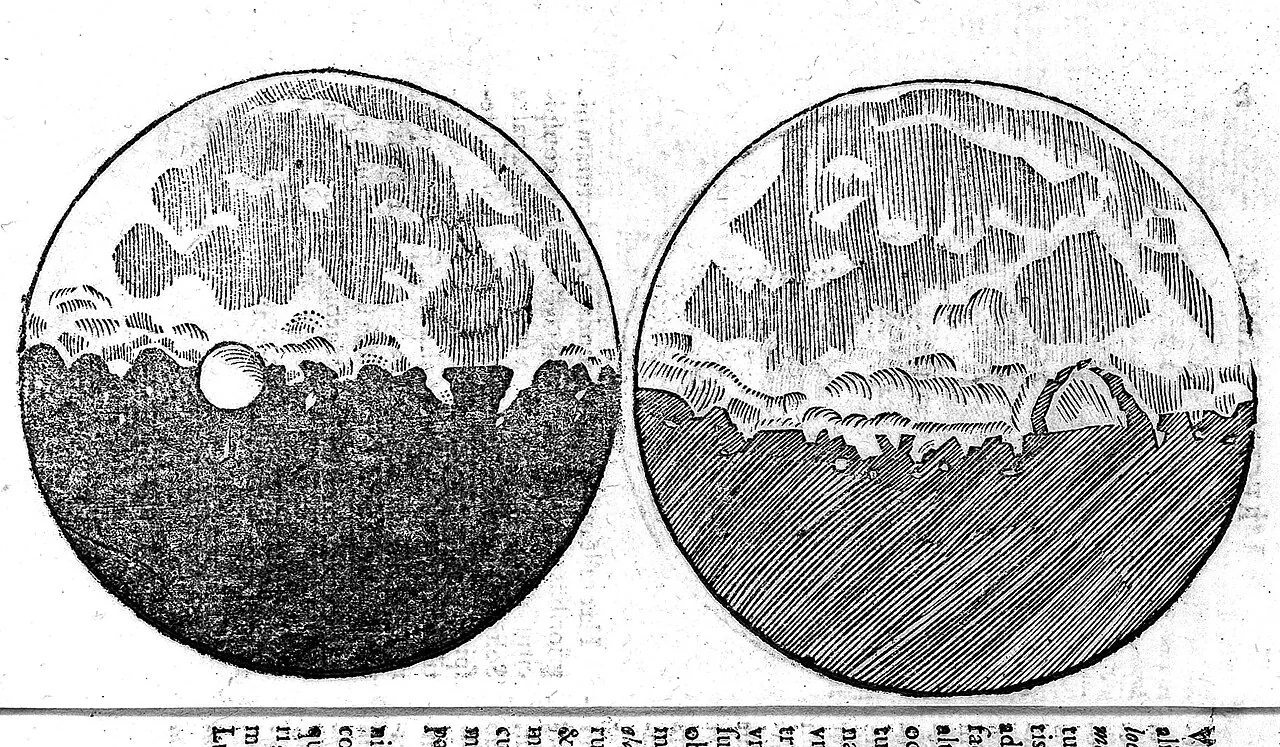
Galileo's telescopic work undermined familiar assumptions about the heavens. The Moon had an uneven surface. Jupiter had satellites. Venus displayed a changing set of phases. These findings helped make a traditional Earth-centered cosmology harder to maintain. They were not received with uniform religious hostility: Jesuit astronomers in Rome confirmed his observations. The scholarly account of Galileo's astronomy.
A distinction matters here. The phases of Venus challenged the traditional Ptolemaic arrangement, but did not by themselves establish that Earth moved. Tycho Brahe's alternative placed Earth at rest while the Sun circled it and the other planets circled the Sun. Such an arrangement could also account for Venus's phases. An observation can eliminate one model without deciding among every remaining competitor.
Galileo also offered a mistaken explanation of tides as evidence of Earth's motions. Recognizing that error neither erases his discoveries nor vindicates a tribunal. A scientist may reach a broadly correct conclusion through a mixture of strong and weak arguments. The appropriate response is to separate those arguments and test them.
Scripture and a disputed standard of proof
In his 1615 letter to the Grand Duchess Christina, Galileo argued that biblical language often accommodates ordinary human understanding. Scripture's authority did not require treating every physical description as technical astronomy. When an established natural conclusion appeared to conflict with a biblical passage, its interpretation needed examination. He made that argument as a Catholic addressing Catholic readers. Galileo's letter.
The question was larger than whether one verse had been misunderstood. Who could say a conclusion was demonstrated? Who had authority to reinterpret a text? And should a plausible physical account be permitted while the evidence was still developing? These issues concerned the management of inquiry as well as its eventual conclusions.
Cardinal Robert Bellarmine's 1615 letter to Paolo Foscarini shows both a qualified openness and a serious restriction. Bellarmine accepted hypothetical use of Copernican calculations. He allowed that a genuine demonstration of Earth's motion would require care in explaining apparently contrary passages. Yet he did not believe such a demonstration existed, and he treated received scriptural interpretation as the position to retain. Bellarmine's letter, in translation.
This was not simply a modern scientist asking for better data. The letter attached religious danger to asserting a physical interpretation. Its conditional willingness to reconsider did not supply the freedom needed to pursue and defend the disputed conclusion.
From restriction to conviction
In 1616 Galileo was admonished not to teach or defend Copernicanism. The precise legal force of the documents associated with that episode remains a matter of historical dispute. Copernicus's book was suspended pending correction. In 1632 Galileo published the Dialogue Concerning the Two Chief World Systems, formally a discussion but plainly favorable to the Copernican position. The earlier restriction became central to his trial the following year. The chronology and documentary difficulties.
Personal relationships, patronage, and political circumstances shaped the conflict. They do not remove its theological content. The sentence explicitly condemned the astronomical propositions and their relationship to Scripture. Calling the case merely a quarrel about Galileo's personality or a technical breach of permission misdescribes the judgment itself.
His imprisonment was commuted to house arrest, which continued until his death in 1642. He was not executed for his astronomy. Nor does the absence of execution make confinement and compelled recantation harmless. The punishment constrained a person and delivered a warning to others considering similar arguments.
What the later acknowledgment means
In 1992 John Paul II addressed the Pontifical Academy of Sciences after a study of the affair. He identified an error among the theologians who regarded the physical structure of the world as imposed by Scripture's literal sense. The address called for attention to the different methods appropriate to different fields of knowledge. John Paul II's address of 31 October 1992.
That statement should not be advertised as the moment the Church finally discovered that Earth moves. Nor should a speech be treated as a fresh trial verdict. It was an institutional reflection on a much older failure, and its adequacy can itself be discussed. Acknowledging error is valuable; it cannot undo what happened to Galileo or substitute for understanding the mechanisms that produced the error.
The Second Vatican Council had already affirmed the rightful independence of scientific methods in Gaudium et spes. That principle becomes meaningful when it protects inquiry before its conclusions are comfortable. The council's teaching, paragraph 36.
A lesson that applies before certainty
The hardest lesson is not that people should accept a fact after everyone else has accepted it. It is that institutions need habits that permit correction while an issue is still unsettled. They must distinguish a central commitment of faith from a familiar interpretation attached to it, and distinguish criticism of an argument from a threat to the whole religious community.
For a reader, the practical questions are concrete. What does the observation actually exclude? Which conclusion is scientific, which interpretive, and which theological? What would count against my preferred account? Am I giving an opponent's strongest argument a fair hearing?
Galileo's scientific errors make these questions more useful, not less. Respect for inquiry cannot depend on a researcher being flawless. Catholic confidence in truth is best served by institutions capable of hearing correction, and by an honest memory of what happens when authority tries to settle a physical question through coercion.