
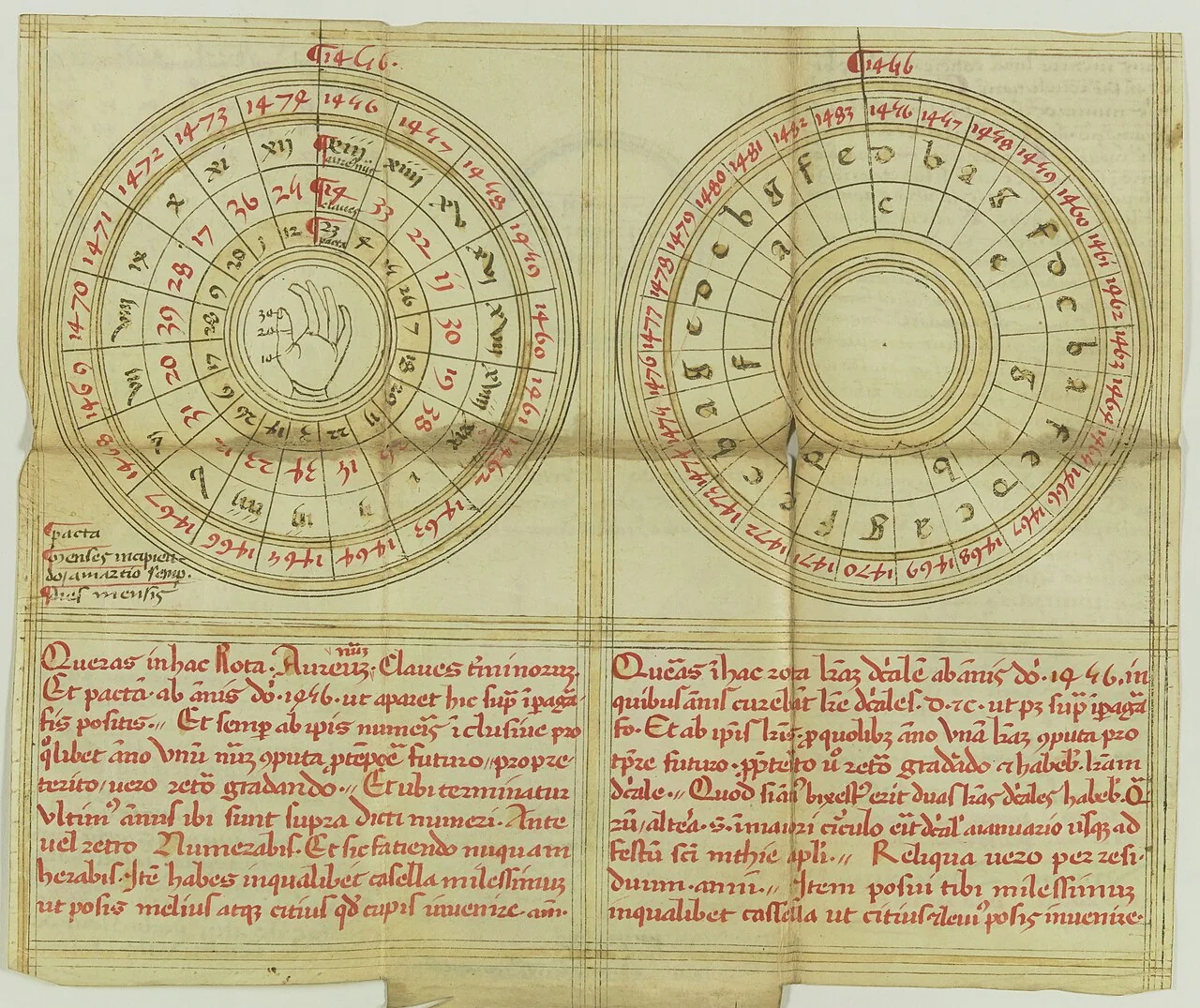

Three clocks on one page
Christmas stays on December 25. Easter can arrive when March still feels wintry or when April is nearly over. The difference is visible on a calendar long before anyone learns the calculation behind it.
The underlying difficulty is that nature has not supplied a single clock. Earth turns, Earth travels around the Sun, and the Moon cycles through its phases. A solar year does not contain an exact whole number of days or lunar months. Meanwhile, the seven-day week keeps its own repeating sequence. Any calendar that tries to coordinate these rhythms needs rules for handling the leftovers. U.S. Naval Observatory on calendars
Easter brings those rhythms together because its Christian setting includes Passover and its weekly celebration is associated with Sunday. Its date therefore cannot be understood simply as a fixed anniversary on the civil calendar. The feast preserves a relationship among seasonal, lunar, and weekly patterns.
That relationship is real, but the familiar shortcut—“the Sunday after the first full moon of spring”—omits the feature that makes the system workable: the Church uses a calendar calculation.
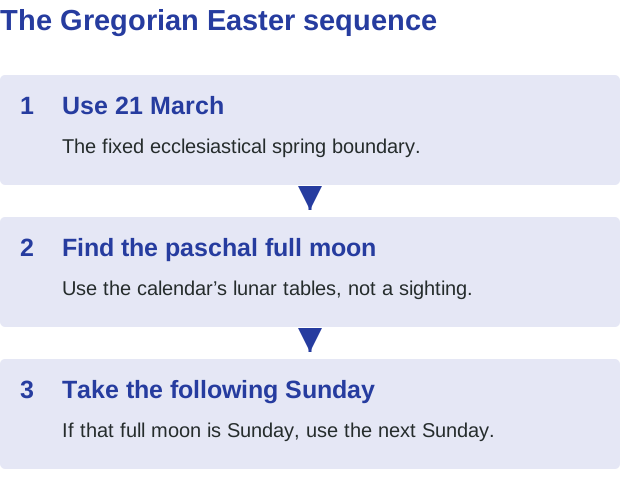
The moon in the rule is a tabled moon
For the Gregorian calculation used by the Catholic Church's Latin liturgical calendar, Easter is the first Sunday following the first ecclesiastical full moon on or after March 21. March 21 is the fixed ecclesiastical equinox. The ecclesiastical full moon is supplied by lunar tables, rather than determined by watching the sky that year. This produces Easter dates from March 22 through April 25. U.S. Naval Observatory's Easter explanation
Two words do considerable work: “on” and “following.” A qualifying full moon on March 21 counts. If the tabular full moon falls on a Wednesday, Easter is the coming Sunday. If it falls on a Sunday, Easter is the Sunday a week later.
These are hypothetical examples of the rule, not astronomical observations. The actual equinox can occur on a different civil date from the fixed ecclesiastical equinox, and the observed full moon can differ from the tabular one. A moonrise photograph cannot by itself tell you that the Easter calculation is wrong.
A calendar needs a date that communities can identify in advance and share. Imagine requiring every parish to determine Easter from its own horizon, weather, instruments, and local time. A globally usable rule avoids turning the celebration into an annual dispute over observations. The tables encode an astronomical approximation in a common convention.
Why reform became necessary
The Julian calendar treated every fourth year as a leap year. Its average year was slightly too long relative to the cycle of seasons, allowing calendar dates and seasonal markers to drift apart over centuries. The Gregorian reform changed the leap-year pattern: century years are leap years only when divisible by 400. Thus 2000 was a leap year; 1900 was not. The reform also addressed the lunar calculations relevant to Easter. The Naval Observatory's calendar history
When the reform began in 1582, the places adopting it skipped ten calendar dates. This corrected the accumulated date offset; it did not remove ten days of physical time. A person who went to sleep under one date woke the next morning under a later numerical label.
The history involves several contributors. Aloysius Lilius developed the central reform proposal; his brother Antonio presented it after his death. The Jesuit mathematician Christopher Clavius became an important defender and expositor of the system. Calling Clavius the sole inventor erases the collaborative history. The Vatican Observatory's account also emphasizes the aim of keeping the calculation practical enough to use without specialized astronomical expertise. Vatican Observatory on astronomy, calendars, and religion
There is an instructive relationship between observation and convention here. Astronomical investigation reveals that a calendar is drifting. A human decision establishes how to correct it. The decision is informed by science without being something that a telescope can legislate.
A moving date can express a stable meaning
For Catholics, Easter celebrates Christ's Resurrection. The computation schedules that celebration; it does not provide evidence that the Resurrection occurred. Neither a successful lunar table nor a mistaken calendar calculation can carry that historical and theological burden.
The celebration is also larger than a single morning. Catholic liturgical norms treat the fifty days from Easter Sunday to Pentecost as one extended festive season. The moving date shapes a substantial part of the worshipping year, including celebrations counted in relation to Easter. USCCB on the Easter season
Seasonal imagery can enrich a celebration, but Easter falls in autumn for Christians in the Southern Hemisphere. Its central claim cannot depend on the arrival of northern spring flowers.
The distinction between meaning and timetable also leaves room for reform. The Second Vatican Council said that it would not object to assigning Easter to a particular Sunday in the Gregorian calendar if the Christians concerned, especially those outside full communion with Rome, agreed. That was a statement of conditional openness, not an announcement that the existing calculation had changed. Sacrosanctum Concilium, appendix
Sharing a feast across different calendars
Christians do not all use the same Easter calculation. Many Eastern Orthodox churches retain a calculation connected with the Julian calendar, while Christian practices contain further distinctions. Consequently, celebrations may coincide in one year and fall on different Sundays in another. A generic claim that every Eastern Christian follows one identical rule obscures that variety. Naval Observatory discussion of Easter traditions
This is partly a mathematical problem and partly a problem of common agreement. Better observations alone cannot decide when communities should change an inherited liturgical practice. The question also involves authority, continuity, and the value of celebrating together.
Next time Easter appears to jump across the calendar, there is a useful exercise: find March 21, find the qualifying ecclesiastical full moon in the tables, and move to the following Sunday. The apparently wandering feast becomes a meeting point of several orderly cycles. Its movement is the visible mark of the work required to keep them together.