
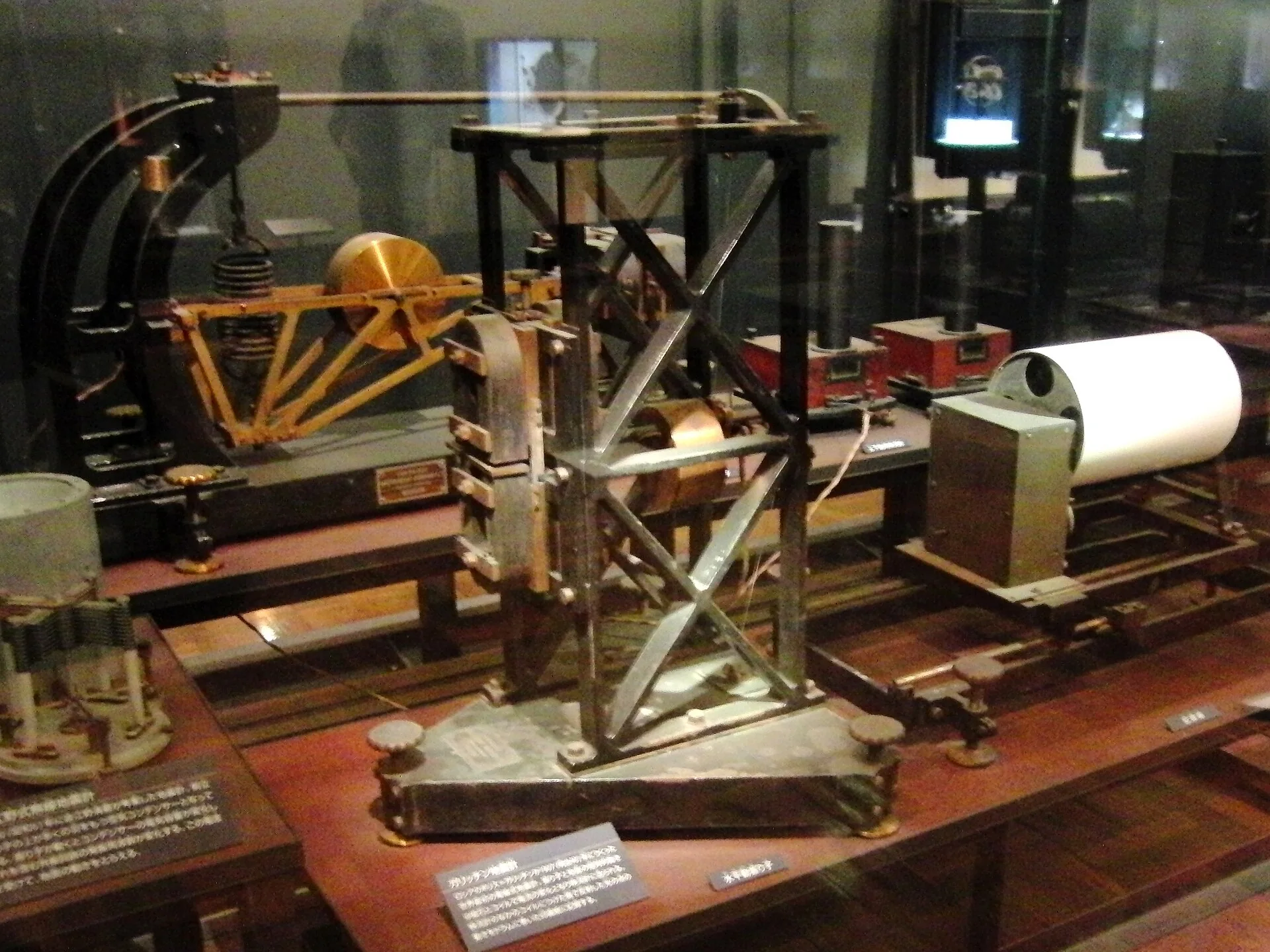

The ground can move beneath an instrument while the people nearby notice nothing. A sufficiently sensitive seismometer records vibrations arriving from an earthquake far away. Its trace is a message carried through Earth: timing, movement, and structure written into a changing signal.
Jesuit institutions helped build an important part of the history of recording those messages. One central figure was Father James Bernard Macelwane, a physicist and geophysicist associated with Saint Louis University. His work illustrates a form of scientific contribution that depends on networks, training, and maintaining instruments over long periods. The university archive's biography.
“Listening” is a metaphor. The records are measurements of motion, not ordinary sound recordings. But it captures the discipline of letting a physical event tell investigators something they could not establish by argument alone.
How to measure a moving Earth
A simple seismometer exploits inertia. A mass tends to resist changes in its motion while the instrument's support moves with the ground. The relative movement between them can be detected and recorded. In an older mechanical instrument, the resulting trace might be drawn on a moving surface; modern instruments use electronic measurements. The US Geological Survey's explanation of seismographs.
The apparatus is not perfectly isolated from its surroundings. Traffic, weather, and local activity can contribute signals. The instrument also has its own response: how readily it moves at different frequencies, and how that movement relates to actual ground motion. Calibration is the work of understanding that relationship well enough to interpret a record.
A mark on a chart therefore does not announce its own cause. An investigator must identify patterns, compare times, and check other stations. If distant instruments register arrivals that fit an earthquake model, the case becomes much stronger than an unexplained wiggle at one site.
A priest becomes a geophysicist
Macelwane entered the Society of Jesus in 1903 and was ordained in 1918. He studied at the University of California, Berkeley, receiving a doctorate in 1923, and returned to Saint Louis University in 1925. There he developed geophysics research and education across seismology and related fields. The archive's account also records his role in organizing the Jesuit Seismological Association. Macelwane's documented career.
Those facts provide the specific Catholic connection. A religious vocation and institutional assignments helped shape a career in a demanding scientific field. They do not explain the behavior of seismic waves; that required physics and observation.
The Association's twenty-fifth-anniversary volume, covering 1925–1950, lists stations at institutions across North America, including sites in Buffalo, Chicago, Cincinnati, Denver, New Orleans, and the western United States. Even its contents page reveals the scale of cooperation. This was a distributed undertaking, not one priest working alone with a mysterious machine. The contemporary commemorative volume.
A network also demands unglamorous continuity. Someone must keep time accurately, maintain equipment, preserve records, and share measurements in a usable form. A station that works intermittently may miss the event needed for a comparison. Reliability itself becomes a scientific contribution.
Why two arrivals are better than one
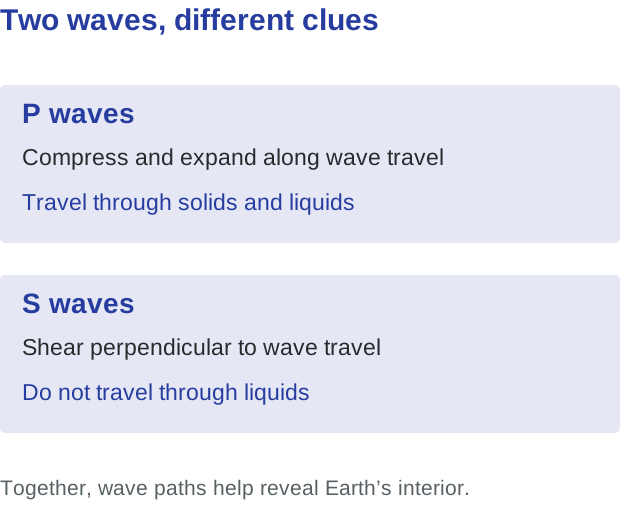
An earthquake generates different kinds of waves. P waves involve compression and expansion in the direction of travel. S waves involve shear motion and generally arrive later. Because their speeds differ, the interval between their arrivals contains information about the distance from the earthquake to the observing station. The USGS introduction to earthquake science.
Imagine two runners leaving the same place at the same time, one faster than the other. The farther they travel, the greater the gap between their arrival times. Seismic interpretation is more complicated because Earth is layered and waves follow different paths, but the analogy explains why a time difference can become a distance estimate.
One distance does not locate an earthquake uniquely. It describes a set of possible locations. Records from additional stations help narrow the possibilities, and travel-time models account for how waves move through the planet. Accurate clocks and well-characterized station positions are therefore part of the scientific argument, not incidental administrative details.
This is a powerful reason to cooperate. Each observatory has a limited view, while the combination can answer a question no individual station can settle as well.
Useful knowledge without a promise of prediction
Magnitude and intensity answer different questions. Magnitude characterizes an earthquake's size at its source. Intensity describes the shaking and effects at a particular location. Different places can experience very different intensities during the same earthquake. USGS on magnitude and intensity.
The distinction helps connect an instrument's record to public safety. Knowing an event's size is not enough to know what every community experienced. Distance, local ground conditions, and the built environment matter to consequences. Understanding hazards requires more than a dramatic number in a headline.
Seismology also should not be credited with an ability it does not possess. Scientists cannot reliably predict the exact time, location, and magnitude of a future major earthquake. Forecasting probabilities and issuing early warnings after an earthquake has begun are different activities. The USGS account of prediction and its limits.
Admitting that limit does not make the science useless. Hazard assessment and better understanding of shaking can inform decisions that reduce harm. The alternative to certainty is often responsible preparation, not ignorance.
Service through a faithful record
An earthquake raises human questions that its waveform cannot answer: grief, vulnerability, and the uneven resources communities possess. A scientific account of the mechanism does not explain why a particular person suffers. It can nevertheless support action on that person's behalf by improving understanding of physical danger.
Macelwane's career offers Catholic readers a concrete way to think about intellectual service. Teaching and maintaining a research network can help strangers whom a scientist will never meet. The benefit may depend on work done years before anyone recognizes its relevance.
The work continued through institutions that maintained instruments, joined observations, trained researchers, and preserved records. That shared preparation is a large part of Macelwane’s contribution to seismology.