

The short version
Antonia Raco reported regaining her ability to walk during a 2009 pilgrimage to Lourdes after years of neurological illness. Her case then underwent years of medical investigation. In April 2025, her bishop recognized the recovery as miraculous. The public record gives a chronology of her illness and the investigators’ conclusions; it stops short of a clinical case report that would let other neurologists examine their reasoning in full. Diocesan announcement
The story
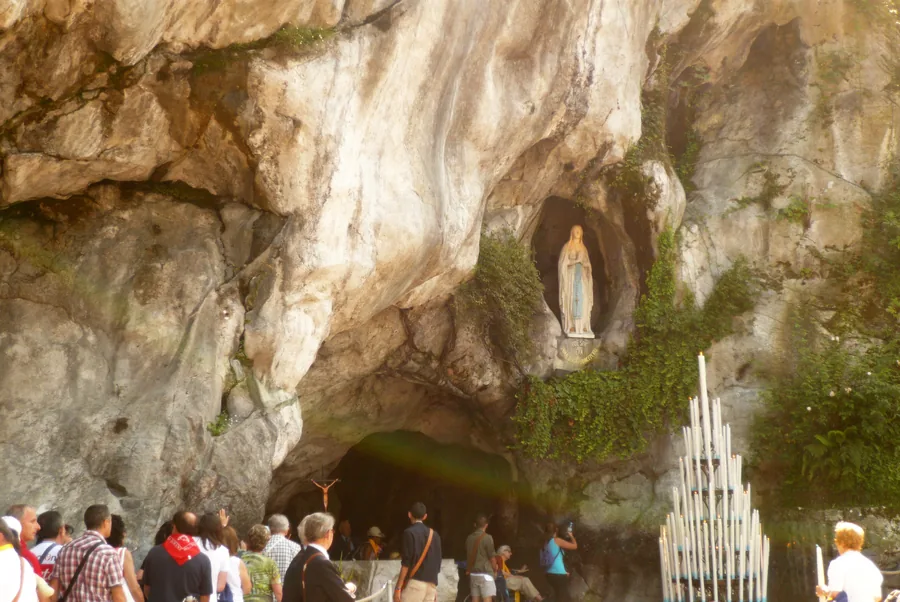
Raco travelled to Lourdes with the Italian pilgrimage organization UNITALSI between 30 July and 5 August 2009. According to the sanctuary’s account, she felt an unusual sense of well-being at the baths and found she could walk again. She waited until she returned home to speak about it.
The same chronology describes a substantial loss of function before the pilgrimage: walking difficulties began in 2004, speech and swallowing difficulties followed, and doctors diagnosed primary lateral sclerosis, or PLS, in 2006. By 2008, it reports weakness affecting all four limbs and reduced forced vital capacity, a measure of breathing function. Examinations in August and September 2009 reportedly found her earlier symptoms had disappeared. Milan neurologists reviewed and confirmed the diagnosis in 2013 and continued her follow-up.
In November 2024, the International Medical Committee of Lourdes voted by majority that her recovery was unexpected, complete, lasting, and medically unexplained. Its assessment referenced modern PLS diagnostic criteria. The sanctuary reports a majority decision but gives no vote tally in this chronology. Sanctuary chronology
Three stages. Different questions.
What changed, and what records document the change?
Can the recovery be explained by current medical knowledge?
What religious interpretation does the bishop reach?
PLS affects upper motor neurons, nerve cells involved in carrying movement commands from the brain. Progressive stiffness and weakness can make walking, speaking and swallowing increasingly difficult. Diagnosis depends on the pattern over time and on excluding conditions that resemble it, including some forms of amyotrophic lateral sclerosis. This makes the pre-recovery diagnosis central to the investigation: a lasting reversal of a progressive disease is a different clinical claim from improvement in a condition that can fluctuate or recover. PLS diagnostic consensus
Lourdes describes an investigation that compares records from before and after a reported recovery, seeks specialist opinions, and assesses whether the improvement is exceptional in light of scientific knowledge. This is a medical inquiry into an individual case. Its conclusion then informs a separate religious discernment. Lourdes investigation process
For Raco, Bishop Vincenzo Carmine Orofino of Tursi-Lagonegro appointed a medical and theological commission after receiving the medical conclusion. On April 16, 2025, he formally recognized her healing as miraculous and as a divine sign. That is the precise Church decision being reported here. Diocesan announcement
The questions that remain
An unexplained recovery invites attention. It does not, by itself, identify its cause. A conclusion that available medical knowledge does not explain an event leaves open the possibility that further knowledge could change that assessment.
The public summaries leave several clinical questions unanswered: the original neurological findings, how competing diagnoses were excluded, the treatments she received and the measurements used during follow-up. We have not inspected Raco’s complete clinical dossier. The account here therefore reports the investigators’ assessment rather than offering a second medical assessment of her case.
For Catholics, the bishop’s judgment concerns how to receive the recovery as a sign of God’s action. Catholic teaching understands miracles as signs of divine revelation that support the credibility of faith. Catechism §156 The same tradition describes Jesus’ healings as acts of compassion that point toward salvation of the whole person. That gives a healing its Christian meaning beyond the surprise of an unexplained medical event. Catechism §§1503–1505
And what about people who pray and remain ill? Their suffering must never become a footnote to a healing story. The Catechism explicitly acknowledges that even fervent prayer does not always bring physical recovery. Continuing illness is not grounds for blaming someone's faith. Catechism §1508 Bernadette Soubirous’s later life at Nevers gives this question a human history: she cared for others while living with recurring illness herself.
Examine the methods & evidenceOptional · 2 min extra
Diagnostic criteria, medical records, and alternatives
The table scrolls horizontally on small screens.
| Evidence or judgment | What this article can establish |
|---|---|
| Formal Church recognition | The diocese's announcement records the bishop's decision and date. It is an announcement of the decision, rather than the complete investigation file. |
| Reported clinical assessment | The sanctuary summarizes the medical history, follow-up, and committee conclusion. This is institutional reporting of that assessment. |
| General diagnostic standards | The consensus paper explains PLS diagnosis. It is not a clinical case report about Raco. |
| Independent medical verification | We have not inspected the full clinical dossier or obtained an independent neurological review. |
What would establish the original diagnosis?
The 2020 consensus criteria require at least two years of progressive upper motor-neuron symptoms and signs in at least two of three regions: legs, arms, and speech or swallowing pathways. They also require exclusion of plausible alternatives. Their distinction between probable and definite PLS depends on follow-up without significant active lower motor-neuron degeneration. The later diagnostic study linked here examines those criteria in other patients; neither paper supplies Raco’s examinations. Diagnostic research
What changed, and how was it measured?
An independent reviewer would want dated neurological findings, electrical muscle tests where relevant, documented walking and swallowing function, and repeated follow-up. The summaries available to us leave open which of these measurements were collected. The description of the investigation at Lourdes explains why comparisons before and after recovery and specialist opinions matter. Official investigation process
Which alternative explanations deserve examination?
The diagnostic literature identifies inherited, inflammatory, structural, and other neurological conditions that can resemble PLS. A fair review asks how relevant alternatives were excluded. Diagnostic differential
It should also examine the treatment and rehabilitation history and any changes in how function was assessed. Each proposed explanation needs evidence from the recorded course and objective findings. A conceivable alternative still has to fit this patient’s history.
What would strengthen our independent assessment?
An appropriately consented, anonymized clinical report could provide examination results, treatment history, follow-up, and the reasoning used to exclude alternatives. Assessment by neurologists outside the original investigation would add another opportunity to examine that reasoning. Those publications would help readers examine the medical reasoning; their absence from this article tells us nothing about whether the investigators collected the relevant records. The International Medical Association of Lourdes also advertises a special bulletin devoted to Raco’s case. We have not reviewed that issue or established how much underlying clinical documentation it contains. AMIL bulletin announcement
Source note: based on the linked public sources. No external medical or theological review has been commissioned.
Editorial update · 27 October 2026
Expanded the pilgrimage and reported clinical course, explained PLS and its diagnostic criteria, clarified the Catholic meaning of healing, and consolidated the limits of the public medical account. Original publication: 28 September 2026.