
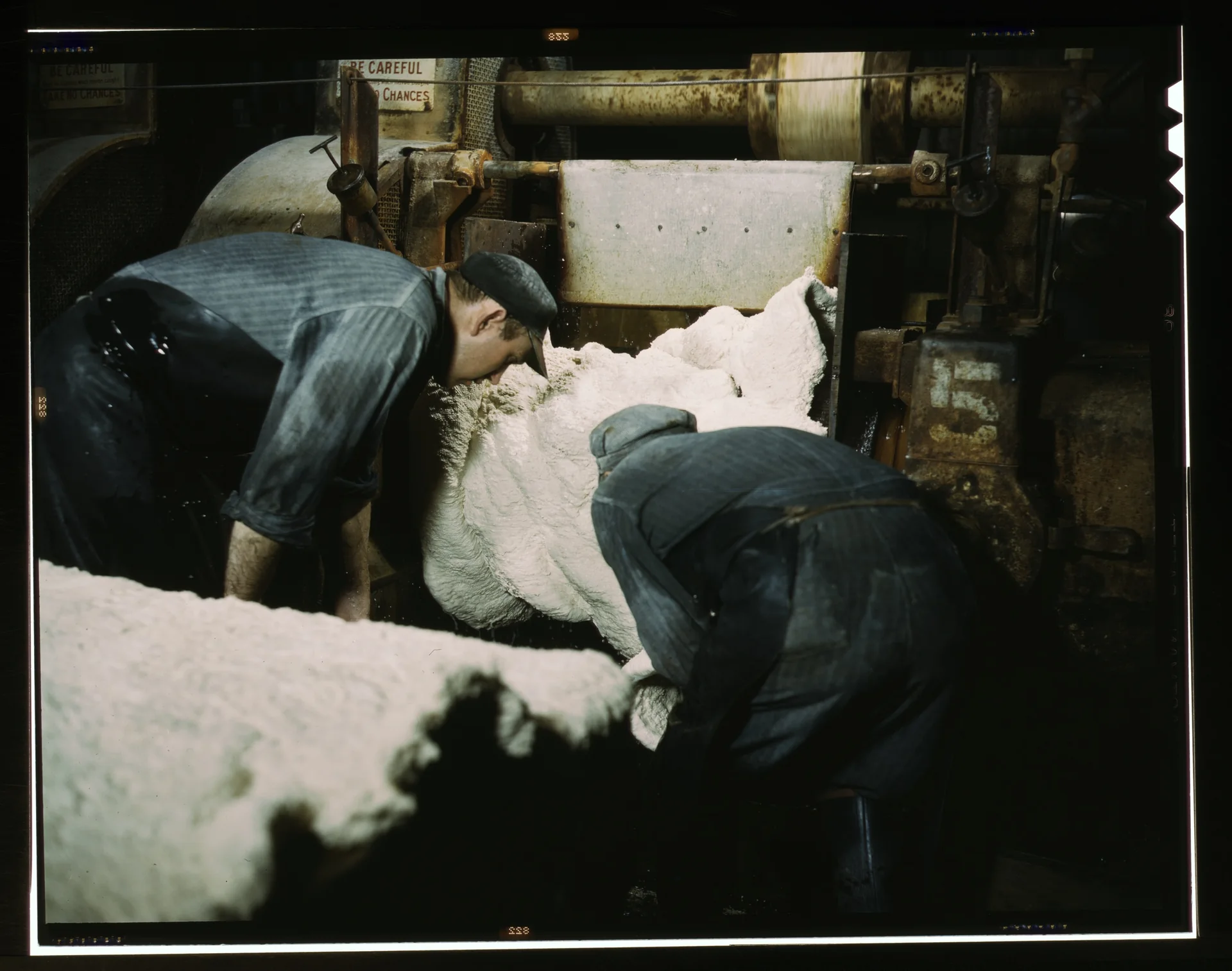

Stretch a rubber band and release it. Its return toward its original shape depends on an invisible arrangement of long molecular chains. Change those chains, or the connections between them, and the material's behavior can change dramatically. The everyday object carries a lesson: chemistry is partly the art of connecting structure on a tiny scale to properties we can feel.
Father Julius Nieuwland, a Holy Cross priest at the University of Notre Dame, contributed to that story through research on acetylene chemistry. His work helped open the route that DuPont researchers developed into neoprene. Saying that a priest simply invented synthetic rubber would lose much of what makes the history interesting. Notre Dame's account of Nieuwland and his collaborators.
The problem of making a useful rubber
A rubbery material has to do more than stretch once. Depending on its intended use, it may need to endure repeated deformation, temperature changes, oils, or weather. A substance that looks promising in a laboratory can still fail as a useful product. Its properties, reliability, cost, and manufacture all matter.
Natural rubber and neoprene are different polymers. A polymer contains very large molecules built from many connected chemical units. In rubberlike materials, flexible chains can change their configurations when a force is applied. Connections within the material help prevent unrestricted flow and allow the material to recover. The details of that network strongly affect its mechanical behavior. IUPAC's educational account of rubber chains and crosslinks.
The analogy of a loose bundle of threads is useful only up to a point. Molecules are in continual thermal motion, and the tendency of chains to occupy many possible configurations contributes to rubber's restoring force. The material is not simply a collection of tiny metal springs. Its behavior depends on chemistry, molecular organization, and temperature together.
Synthetic rubber research needed a material whose properties could be controlled and combined for practical use. Softness was only one requirement.
From an academic reaction to industrial research
Nieuwland studied reactions in which acetylene molecules could be combined into larger compounds. DuPont's Elmer Bolton recognized the possible relevance of that chemistry to a synthetic rubber program. Nieuwland's laboratory work became part of a collaboration and consultation with industrial chemists. The American Chemical Society's history of the research.
At DuPont, Wallace Carothers directed work involving Arnold Collins. Collins isolated the substance chloroprene, which could form a rubberlike polymer. The resulting material was polychloroprene, initially marketed as Duprene and subsequently known as neoprene. Its development involved further chemical and engineering work. The ACS account identifies these contributions rather than assigning the finished material to one person.
The ACS history describes the unexpected step. In March 1930, Collins set aside a small amount of an unidentified liquid from the reaction products. Days later it had become a solid mass that bounced. Analysis identified a chloroprene polymer. A surprising change in a stored sample became useful because someone noticed it, identified the substance and followed it up. The ACS account of Collins’s observation.
Nieuwland’s contribution lay upstream of that result: reactions that supplied industrial chemists with compounds worth investigating. The finished material then needed reproducible chemistry and a manufacturing process. Following those handoffs gives credit to distinct achievements instead of treating development as the automatic consequence of one discovery.
Why the difference from natural rubber mattered
The ACS history describes neoprene's resistance to oils, weather, chemicals, and heat as important to its early applications. It was not initially a cheap replacement for every use of natural rubber. Its value lay in particular combinations of properties that justified its cost. The material's early commercial role.
A seal that resists oil and a low-cost tire make different demands on a material. Success in one application needn’t mean superiority in the other. Price and performance have to be considered together, under the conditions in which the object will actually be used.
Chemical structure helps explain why materials differ, but a label on a polymer does not determine everything about a finished object. Processing, additives, and the way the material is combined with other components also affect its performance. A product's behavior must be tested as a product. Understanding its ingredients is necessary but not sufficient.
The botanist behind the chemistry
Nieuwland's scientific interests extended beyond the reaction associated with his fame. Notre Dame's Museum of Biodiversity credits him with founding its herbarium in 1904 and acquiring the Edward Lee Greene collection in 1914. A herbarium preserves plant specimens with information that allows later researchers to examine and compare them. The Greene–Nieuwland Herbarium's history.
A preserved plant can be checked against the label its collector supplied. A chemical sample can be tested against the substance its discoverer thinks it is. Nieuwland’s two fields each rewarded the ability to keep, distinguish and revisit material evidence.
His life also exposes a harder side of chemical discovery. Notre Dame’s account records that a toxic reaction investigated during his doctorate sent him to the hospital. He avoided further study of the reaction. Another chemist later pursued the related chemistry as the chemical warfare agent lewisite. Nieuwland’s connection to that history belongs beside the useful polymer; it gives the question of responsibility a specific object. Notre Dame’s account of the doctoral research and its later use.
Creativity brings responsibility
Catholic thought provides resources for valuing technical creativity while asking how it is used. Laudato si’ welcomes scientific and technological achievements but rejects the assumption that increased power automatically becomes human progress. The questions of purpose, consequences, and responsibility remain. Francis on technology, paragraphs 102–105.
A researcher cannot foresee every later use, but neither can a useful invention settle all the moral questions about the research that produced it. The same career can lead us toward a helpful material and toward chemistry developed for chemical warfare. Catholic judgment has to follow those purposes and the choices behind them; the inventor’s priesthood cannot supply the verdict.
Follow what happened after a compound left the university laboratory: who developed it, what it was used for, and who bore the risks. The history continues beyond the discovery, through decisions with consequences for other people.