
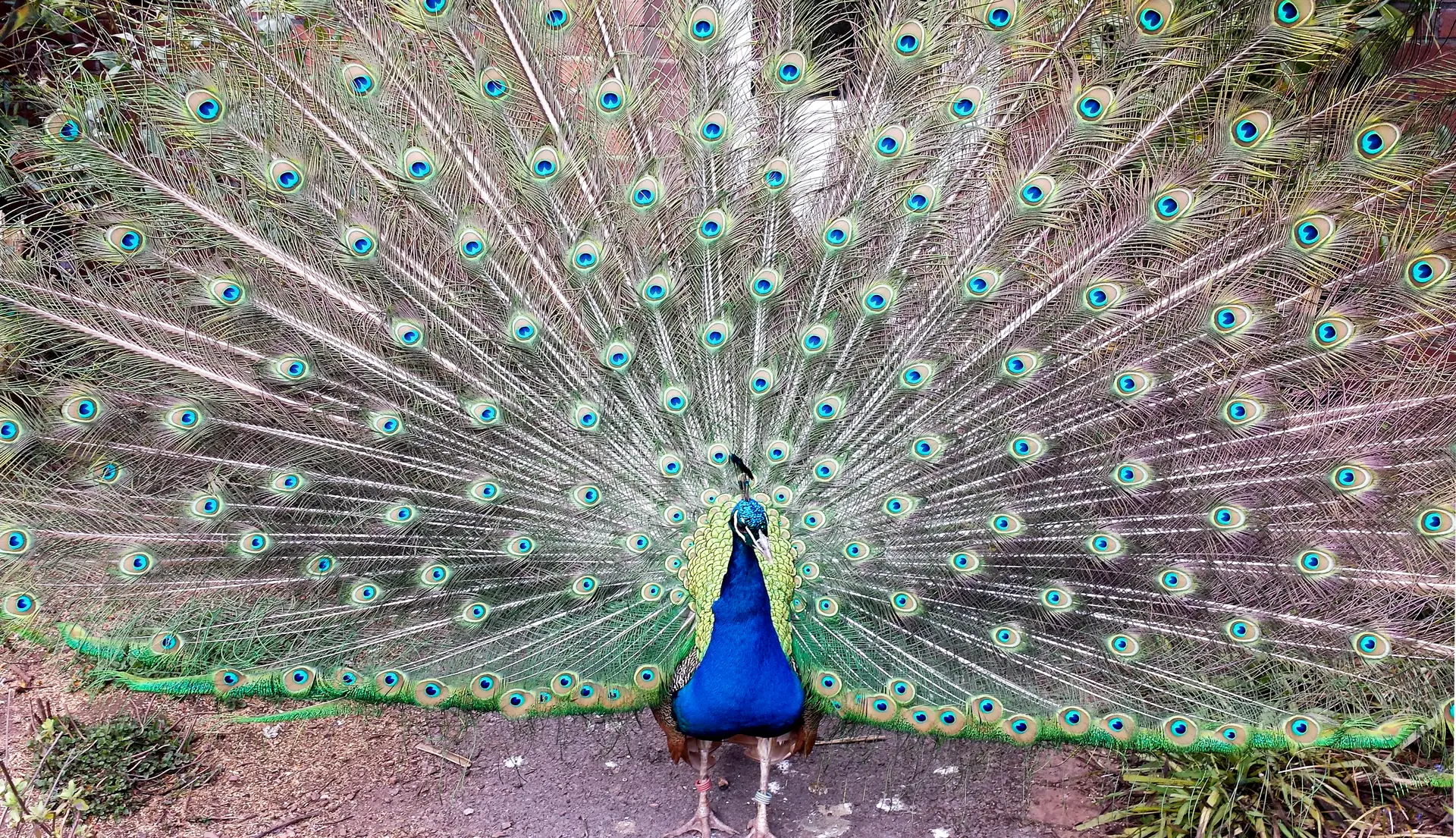

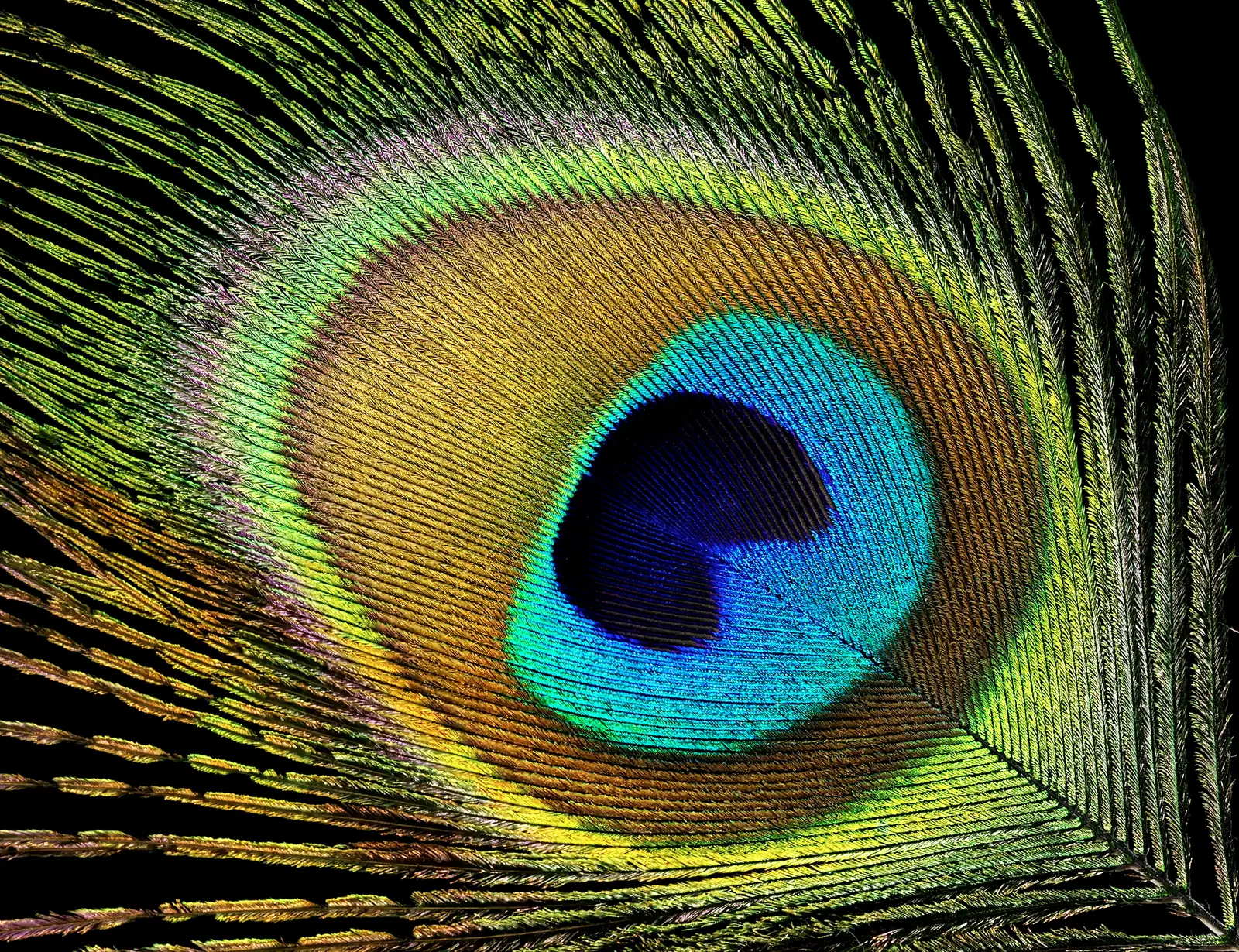
Choose one patch of a peacock feather and watch it as the angle changes. A green shimmer may slide toward blue; another part may become unexpectedly dark. The feather has not grown a new pattern in the time it takes you to move your head. Something about the route from the light to the feather to your eye has changed.
That small observation opens a surprisingly large question. We often speak of color as something an object simply has: a red cup, a yellow pencil, a blue feather. But a peacock’s iridescence—the shifting color seen from different angles—makes the encounter between an object and light hard to ignore. [1]
Color built into a structure
Pigments produce color by absorbing some parts of the light that reaches them more strongly than others. Structural color depends on the arrangement of matter at very small scales. In a feather, that arrangement can favor the reflection of particular wavelengths. These are two different contributions to what we see, and one feather can involve both. [1]
Light behaves as a wave. When waves overlap, their peaks and troughs can reinforce one another or partly cancel. Physicists call this interference. The distances traveled matter: change the paths, and you change which waves arrive in step. Visible light has wavelengths measured in hundreds of nanometers; a nanometer is one-billionth of a meter. Structures on that scale can therefore have effects large enough for our eyes to notice. [2]
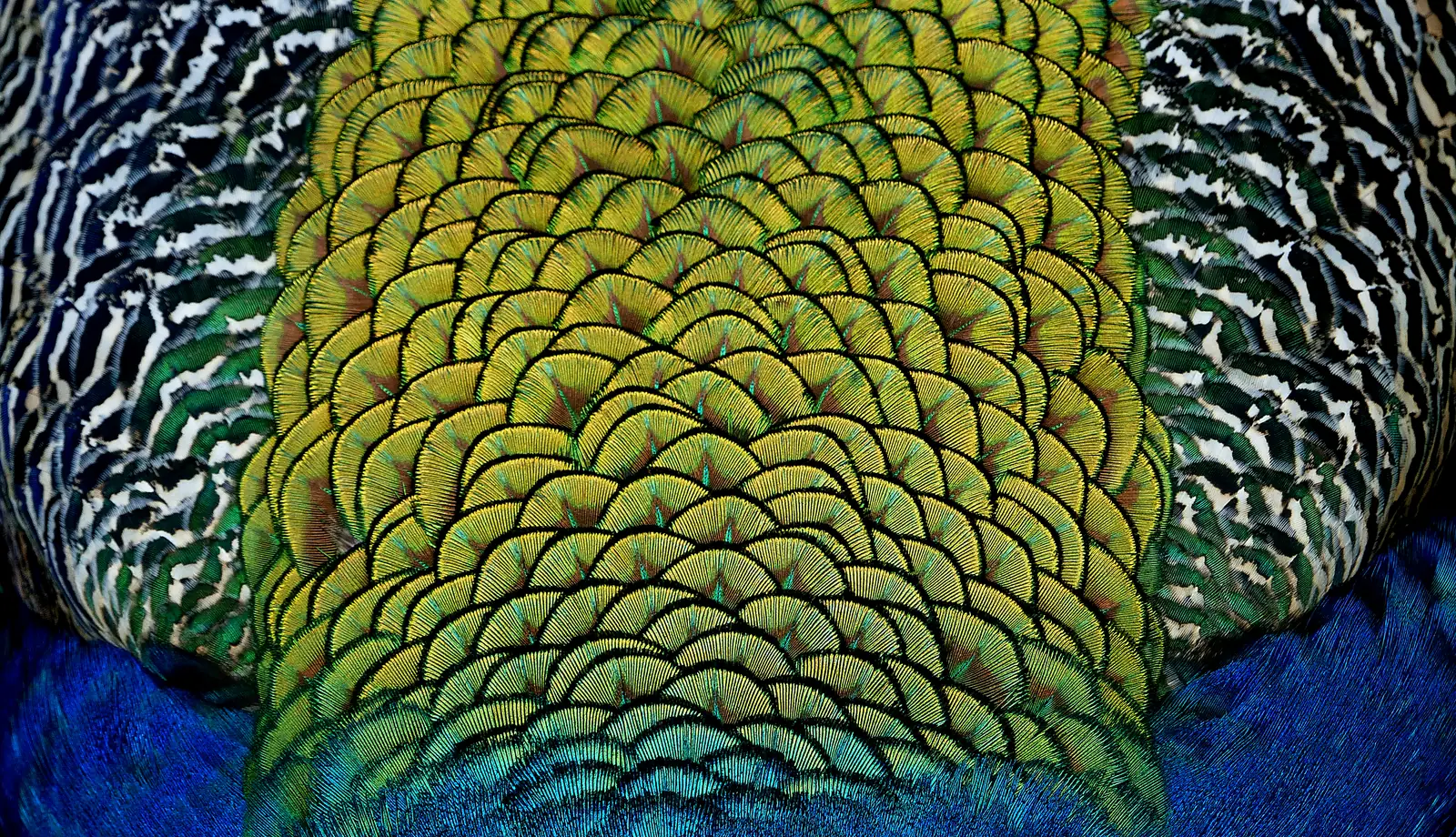
In 2003, Jian Zi and colleagues examined colored regions of a male green peafowl’s eyespot feather, using microscopy, reflectance measurements, and computer calculations. Inside the tiny branches called barbules, they found orderly arrangements of melanin rods and air channels within keratin, the feather’s structural material. Different colored regions had different spacings and numbers of repeated layers. [3]
Those dimensions helped explain which wavelengths the feather reflected most strongly. The arrangement works as an optical structure: some colors are reinforced in the light returning toward the observer. Their calculations predicted that, as incoming light strikes at a more slanted angle, the range of strongly reflected wavelengths shifts toward shorter wavelengths. Changing an angle changes the optical conditions without requiring the feather’s chemistry to change. [3]
So the shimmer is real. It is also conditional. A photograph preserves one combination of feather, lighting, and viewpoint. It cannot show every appearance the same feather could offer as you move around it.

The pigments still matter
It is tempting to shorten this explanation to “there is no pigment.” But melanin is itself a pigment, and its organized rods are part of the structure just described. A distinction between pigmentary and structural effects should help us understand the feather, not make one of its ingredients disappear. [3]
A study published in Animals in March 2026 adds a further question. Gang Wang and colleagues sampled three adult male Indian peafowl and three adult male green peafowl. Using chemical analysis, they detected trace amounts of lutein, a carotenoid pigment, in the feathers. They also found differences in pigment-related gene activity between feather follicles from different body regions. [4]
The researchers propose that lutein helps modify the final color produced by the feather’s structure. That is a useful possibility to investigate, but detecting a substance and finding associated gene activity do not, by themselves, establish exactly how much it changes the visible result. This was a small study, and it did not directly test the color before and after selectively removing lutein while preserving the nanostructure. The well-established optical explanation remains; the possible contribution of this additional pigment needs more testing. [4]

A reason to look more closely
For a Catholic reader, understanding that mechanism can be part of appreciating creation. The Catechism teaches that creatures have their own particular goodness and that people should respect it. In paragraphs 339–341, it links the world’s beauty with the diversity of beings, their relationships, and the order that human inquiry gradually discovers. It presents that beauty as reflecting the Creator. [5]
That is a theological understanding of the world, not a conclusion produced by a microscope. Readers who do not share it can still follow the optical evidence. The Catholic invitation is to bring faith into a more attentive encounter with the creature: to learn what it actually is, including details that complicate a pleasing explanation.
There is a practical discipline here. Admiration can be quick; attention takes longer. It asks us to distinguish what we saw from what we inferred, and what a study measured from what its authors proposed. A beautiful subject deserves that care as much as an ordinary one. Finding an explanation need not bring curiosity to an end. It can give us better things to notice.
If you have a feather to examine, keep the light and feather still and move your head slowly. Pick one small region, rather than jumping between differently colored rings. Then return to your starting position. Does the earlier color return? A photograph can help you remember a moment. The feather lets you keep asking what changes—and what stays the same.