
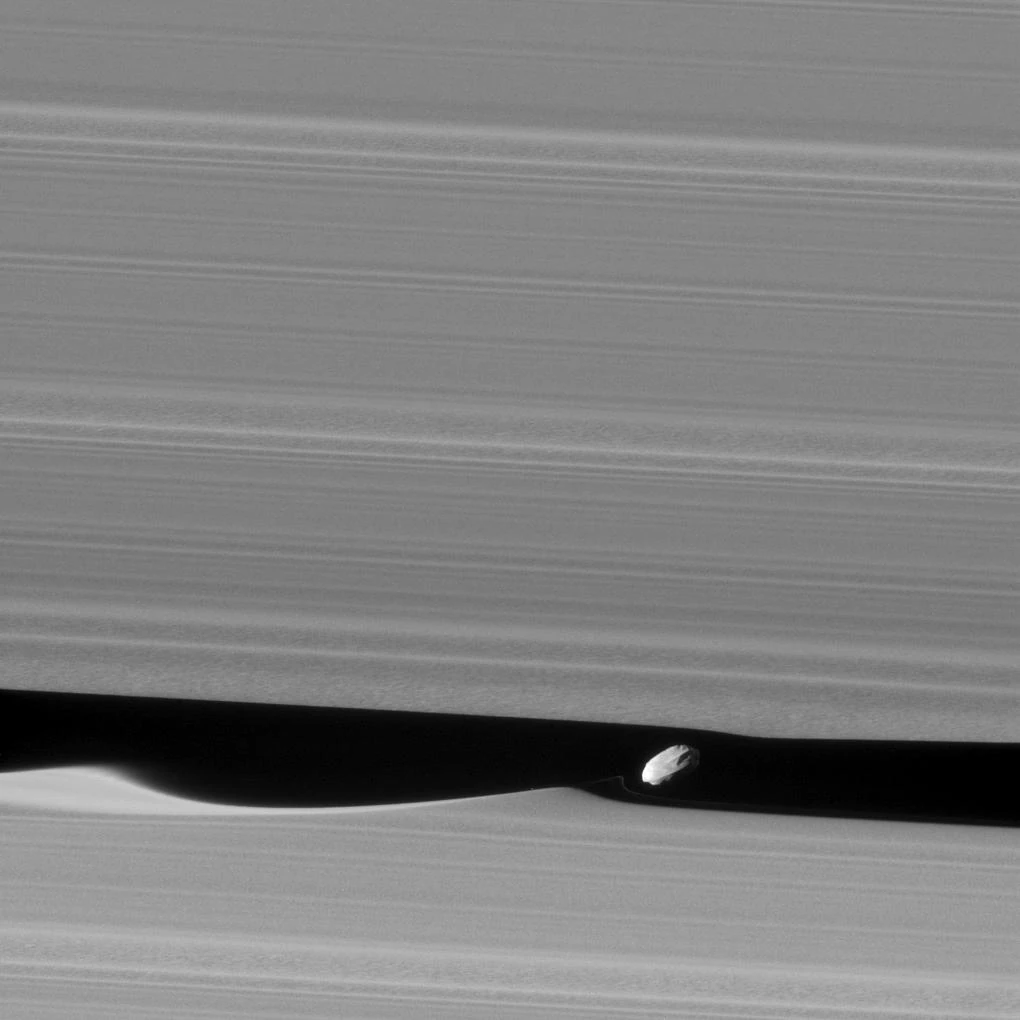
Look closely at Cassini’s photograph of Daphnis. A small, bright moon sits in a dark opening between bands of Saturn’s rings. Beside it, the edge of a ring rises into a wave. There is something wonderfully awkward about that scene: a moon living among material that has not become a moon. [1]
The familiar explanation for Saturn’s rings says that, close to the planet, tidal forces can prevent loose material from gathering into a lasting satellite. So what is Daphnis doing there? The apparent contradiction leads to a better explanation—one that asks what an object is made of and what holds it together. [2]
A ring is a crowd
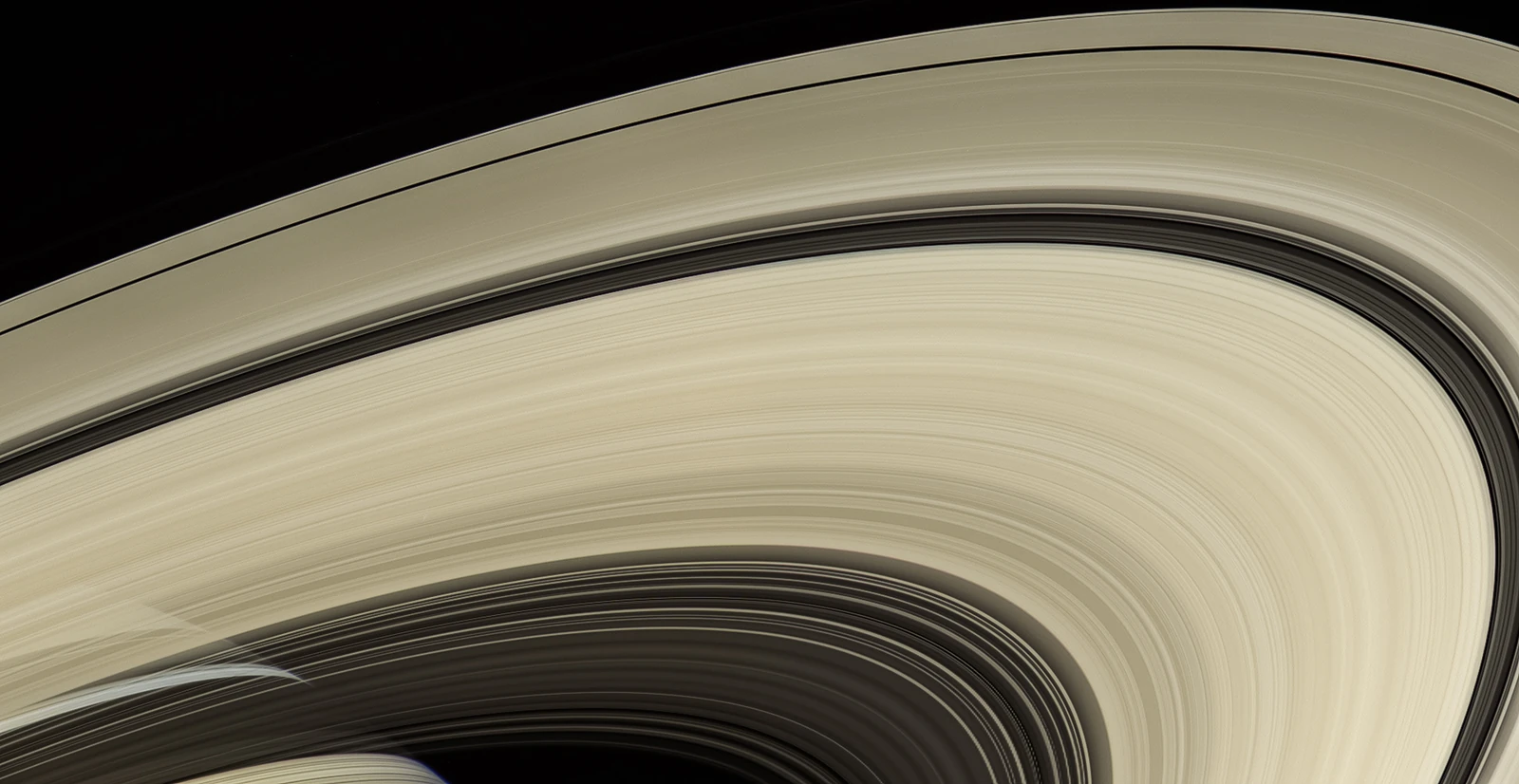
From a distance, Saturn’s broad rings can look like a smooth disk. They are a population of separate objects: mostly water ice, with rocky material and dust. The pieces range widely in size, from tiny grains to much larger chunks. The bright surface in a photograph does not mean we can pick out each of those pieces. [3]
Each particle follows its own orbit around Saturn. The planet’s gravity keeps the whole moving population in its neighborhood, while the particles also attract one another. But Saturn’s pull is unequal across a clump: the side nearer the planet is pulled more strongly than the farther side. That difference produces tidal stretching. If it overcomes the clump’s ability to hold itself together, a lasting moon cannot form from that loose collection. [2]
Notice that two questions have appeared where there seemed to be only one. What keeps a piece traveling around Saturn? And what keeps neighboring pieces bound to each other? Answering the first does not automatically answer the second. An orbit and a durable body are different things to explain.
A limit with conditions
The Roche limit names the distance inside which planetary tides can disrupt a body held together only by its own gravity. That last condition matters. The boundary is not a wall that destroys everything crossing it. Density, rotation, shape, and the strength of the material affect the result. [4]
In a 2013 paper, Matthew Tiscareno and colleagues described the problem through “Roche critical density”: at a particular orbital distance, how dense must a body be for its own gravity to keep it intact? Density means mass packed into a given volume. A denser body has a better chance of resisting tidal disruption than a more loosely packed one under otherwise comparable conditions. [4]
Material strength adds another qualification: a solid piece need not rely on gravity alone. The researchers also discuss Saturn’s small ring moons in terms of denser cores surrounded by loosely packed accumulated material. These are models to investigate, not a direct measurement of Daphnis’s interior. Their analysis concerns substantial rings, not every faint, dusty ring around Saturn. [4]
Consider two loose clumps of the same size at the same distance from Saturn, one packed more densely than the other. The denser clump has more mass to provide mutual gravitational attraction. The planetary environment is the same, yet the clumps need not share a fate. Add material strength and the comparison changes again. That is why placing a moon beside ring particles does not, by itself, contradict the tidal explanation.
The moon changes the picture
Daphnis is about eight kilometers across, orbiting within the 42-kilometer-wide Keeler Gap. Its gravity raises waves both along the ring’s edge and out of the ring plane. Cassini’s viewing angle makes the gap look narrower than it really is. The photograph records a local interaction between a moon and its surroundings, not simply a tiny object against a decorative backdrop. [1]
There is also a separate historical question: where did the rings come from? NASA describes several proposed origins, including disrupted or collision-shattered moons. Explaining why material can remain dispersed is not enough to establish which event supplied it or when. The Roche limit is a tool for understanding the possibilities, not a complete biography of Saturn. [2]
The person behind the name
Édouard Roche was a nineteenth-century French mathematician and astronomer who taught at Montpellier. The Society of Catholic Scientists identifies him as a lifelong Catholic. His place in this story is a concrete one: the mathematics associated with his name still helps astronomers frame questions about the survival of orbiting bodies. [5]
A contemporary memorial by the mathematician Joseph Boussinesq gives that biographical sketch a human foundation. In its closing pages, Boussinesq describes Roche’s Christian religious practice and the religious rites he received near the end of his life. That testimony supports the picture of a practicing Christian; it does not tell us that a particular belief caused a particular calculation. [6]
The Catholic connection extends beyond a scientist’s affiliation. Paragraph 159 of the Catechism presents genuinely scientific inquiry, conducted with respect for moral law, as compatible with faith. Its reason is theological: the realities studied by science and the realities addressed by faith have their origin in the same God. On that understanding, carefully investigating a natural mechanism belongs within a faithful approach to the world. [7]
The investigation gives that conviction practical expression. Daphnis has to be explained in the same physical world as the particles beside it. Its size, density, strength, and orbital setting constrain the possibilities. Faith gives Roche’s work a place within a Catholic life; the calculations must still answer to the rings.
Cassini’s image shows Daphnis disturbing the edge of the ring. Explaining that scene requires an account of the moon’s orbit, its internal strength, and the behavior of nearby ring material. Its earlier history is a further question.